
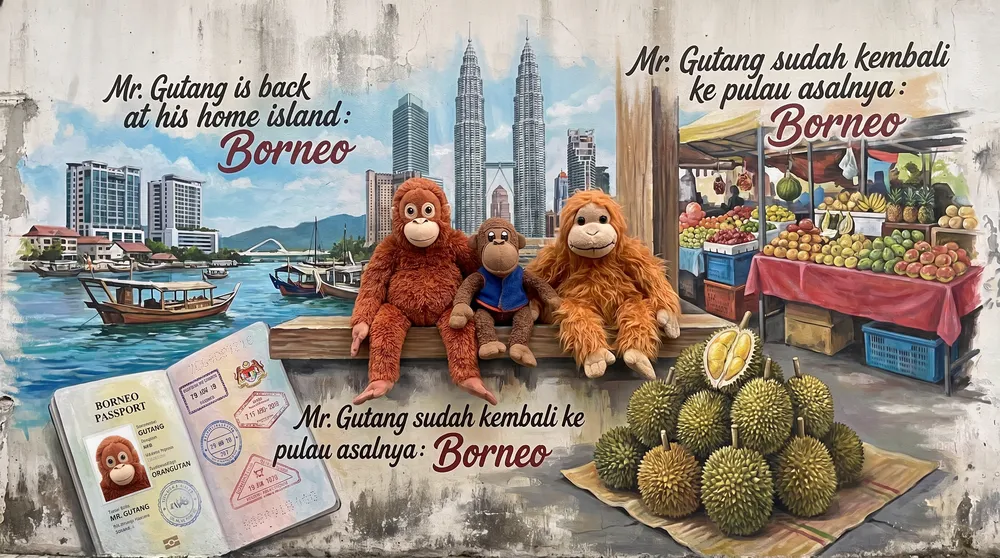
There are birthdays that call for a cake, candles and a quiet evening at home. Then there are Mr. Gutang’s birthdays.
Celebration began with an unusual destination: the Durian Experience Museum. It seemed only appropriate. After all, if one is going to celebrate the birthday of an orangutan with an undeniable appreciation for good food and questionable life choices after work, there are few better places to start than a museum dedicated to Southeast Asia’s most legendary fruit.
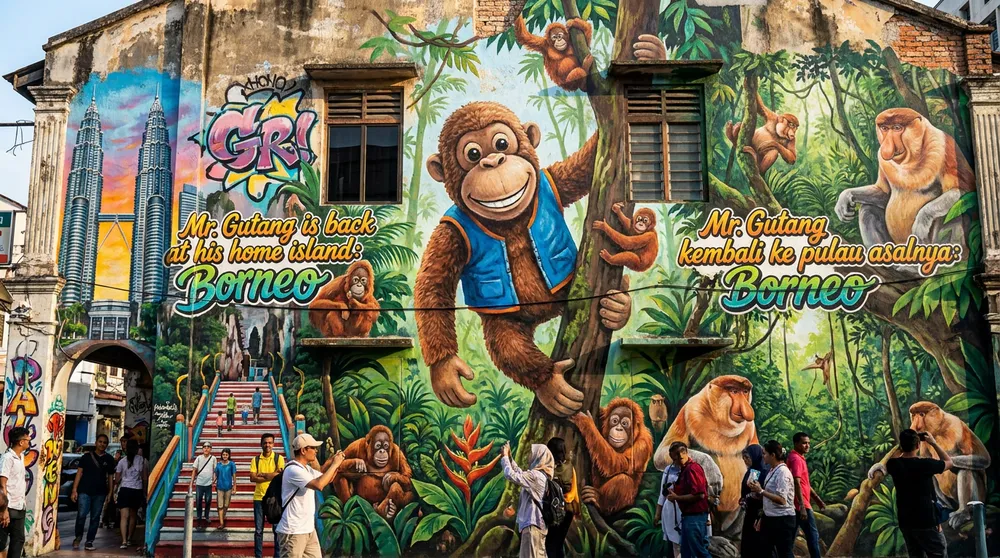
He did not travel alone.
Joining the expedition was the newest member of our travelling family: the famous IKEA orangutan who unexpectedly became an internet celebrity after being selected as step mother of world famous Punch (a monkey at a Japanese zoo).
The museum proved to be exactly what every durian enthusiast hopes for: a place where the history, cultivation and astonishing diversity of the “King of Fruits” are celebrated with equal enthusiasm.
For visitors discovering durians for the first time, one of the biggest surprises is usually the names.
Unlike apples or oranges, many premium Malaysian durian varieties are known by registration codes beginning with the letter D, followed by a number. These are official cultivar registrations rather than marketing inventions. Over the years, however, several varieties have become so successful that their popular names are recognised almost everywhere in Asia.
Among them, none is more famous than Musang King (D197). With its rich, creamy texture, deep golden flesh and remarkable balance between sweetness and gentle bitterness, it has become something of an ambassador for Malaysian durians and is now exported around the world.
Another variety attracting devoted followers is Black Thorn (D200). Produced in smaller quantities and often considered more complex in flavour, it is treasured by enthusiasts who appreciate its intense aroma and custard-like consistency. Mention either name in Malaysia and you are almost guaranteed to begin a passionate conversation.
Mr. Gutang, naturally, declined to express a public preference.
Ground operations supervisors are expected to remain diplomatically neutral.
The connection between orangutans and durians, however, is not entirely fictional.
Wild orangutans are highly opportunistic feeders, consuming hundreds of different plant species throughout the year. When durian season arrives, the fruit becomes one of the forest’s great celebrations. Protected by their thick hands and remarkable dexterity, orangutans can open fallen durians with far greater confidence than most first-time visitors. For them, the famous smell is not a challenge but an invitation.
Perhaps that explains why Mr. Gutang looked unusually comfortable wandering through a museum dedicated to the fruit.
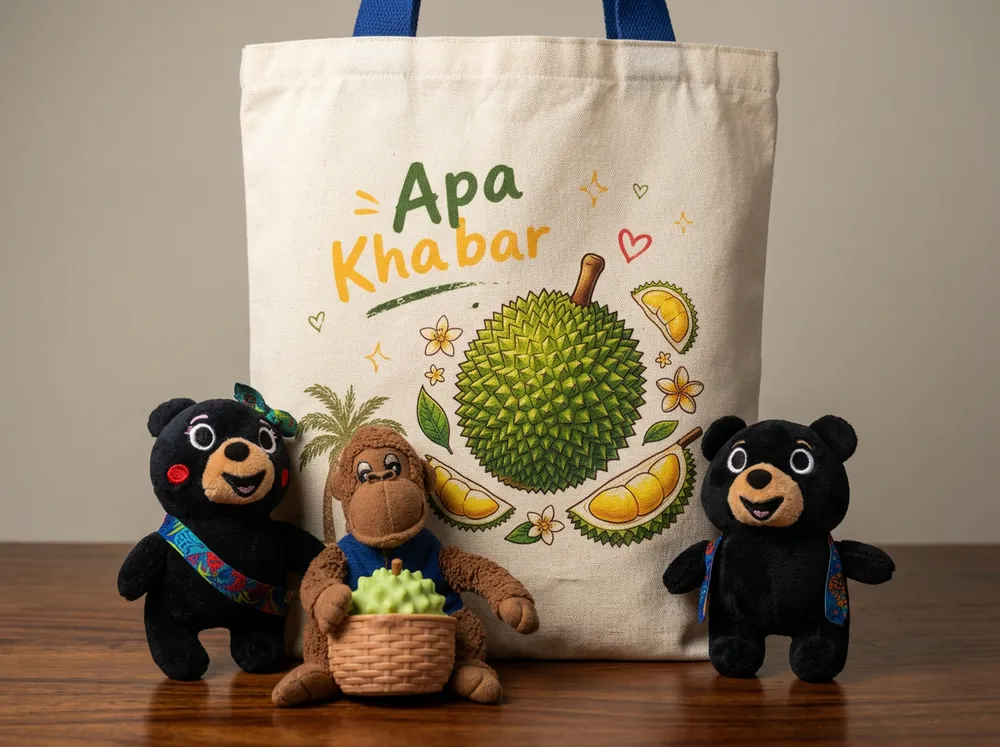
Before leaving, we found a small souvenir worthy of the occasion.
Birthdays deserve presents, Mr. Gutang approved immediately.
Then came the second surprise.
Rather than another toy or another photograph, his 16th birthday gift was considerably more ambitious: airline tickets for the entire family to Kota Kinabalu.
Sixteen years earlier, somewhere among family holidays and half-forgotten photographs, Mr. Gutang’s story had quietly begun in the shadow of Borneo. Whether memory has preserved every detail correctly is almost beside the point. What matters is that the island has always remained part of his story.
A day later, we were there.
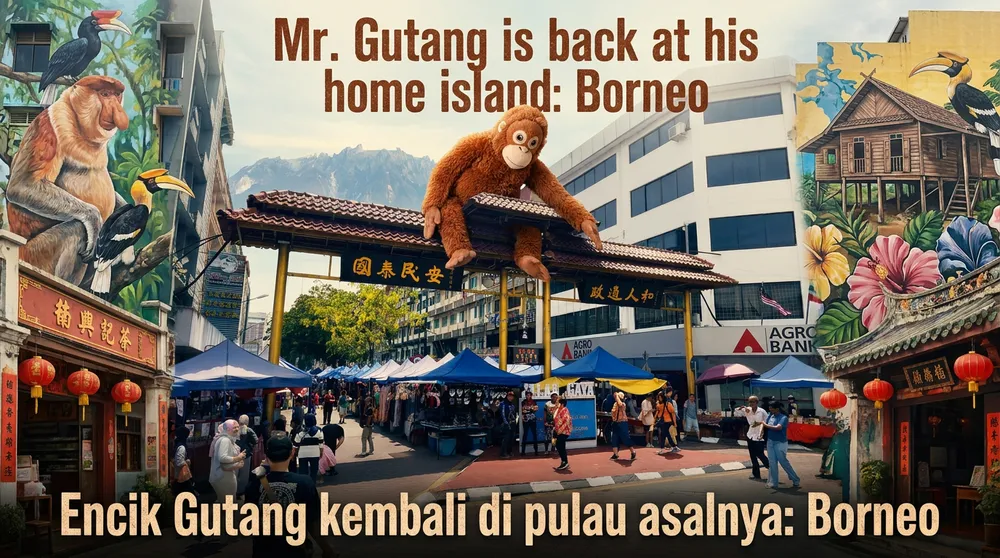
Kota Kinabalu, the capital of the Malaysian state of Sabah, is often described as the gateway to Borneo. Most travellers know it as the starting point for climbing Mount Kinabalu, exploring the islands of Tunku Abdul Rahman Marine Park or venturing into the rainforests that have made Sabah famous among wildlife enthusiasts. Yet the city itself possesses an easy rhythm that encourages visitors to slow down. Waterfront sunsets, bustling markets, seafood restaurants and the constant presence of the South China Sea make it a place where journeys seem to begin naturally.
For us, however, this arrival felt less like the beginning of a holiday than the continuation of a much older story.
Mr. Gutang had come home.
Not to stay.
Only to remind us that every traveller eventually discovers there are places that continue travelling with them, long after the luggage has been unpacked.
The next chapter begins here.