
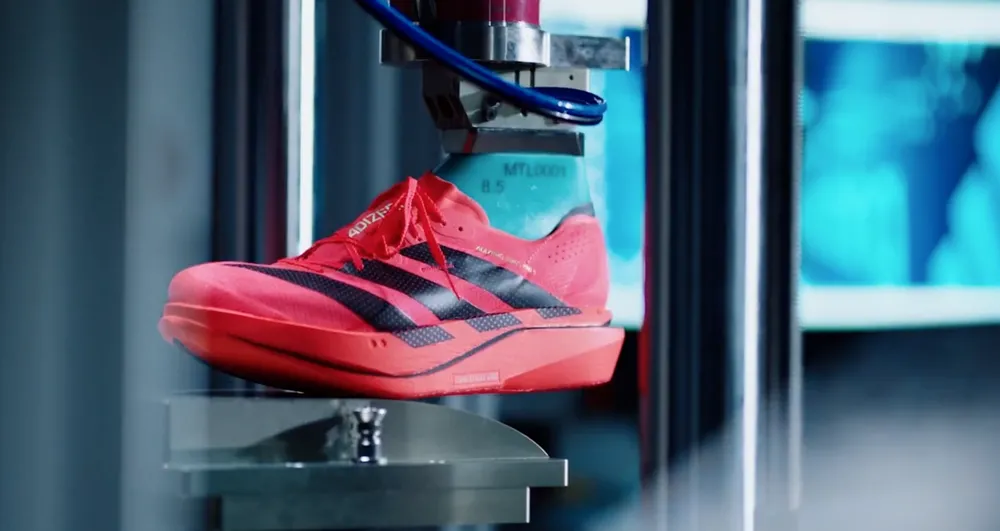
The running community is currently in the middle of a collective reality check. For years, we have accepted the marketing narrative that every new model of a carbon-plated super shoe would be lighter, faster, and superior to the last. But the recent launch of the Adidas Adizero Adios Pro 5 has shattered that illusion, exposing a cynical shift in how major athletic brands treat their most loyal consumer base.
What began as isolated complaints on social media feeds and marathon training forums has started to shift into a structural critique of the entire performance footwear industry. The issues plaguing the latest generation of super shoes maybe aren’t accidental engineering bugs—they can be deliberate features of a modern business strategy engineered to make runners pay more for less.
1. The Shock of the Adios Pro 5 “Issue”
When the first production pairs of the Adios Pro 5 hit the asphalt, the immediate feedback wasn’t about broken course records; it was about broken shoes. Runners who shell out premium capital for a flagship racer expect uncompromising race-day performance. Instead, early adopters were greeted by immediate, visible breakdown.
⚠️ Field Failure Profile: Lateral Forefoot Disintegration
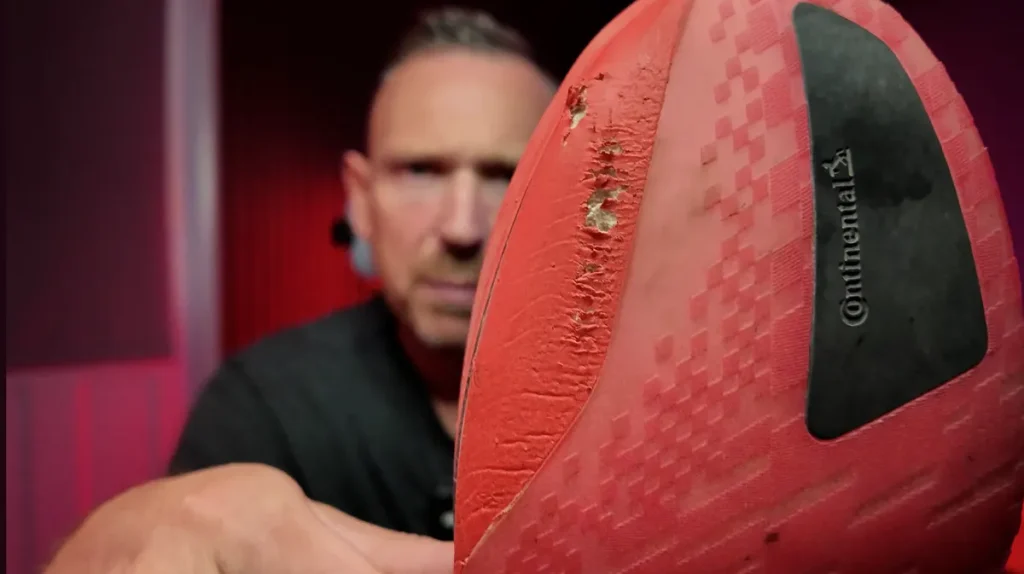
The most alarming reports centered around the rapid degradation of the lateral ante-foot zone. Runners unboxing pristine pairs reported severe peeling, micro-fissure cracking, and physical chunks of the supercritical foam shearing away after a single long run. In a sport where gear is expected to withstand grueling 16-week marathon training blocks, seeing a $250+ flagship disintegrate in real-time caused genuine outrage across the community.
As Runner Reviewer Segasu pointed out, the issues and pictures that arose were, in most cases, the same. This intensified and repeated, creating an echo chamber. This is probably totally true, but, as he also admitted, the solution for Adidas was there and it was an easy one.
2. A “Gimmick” Gone Wrong: The Reality of the Design
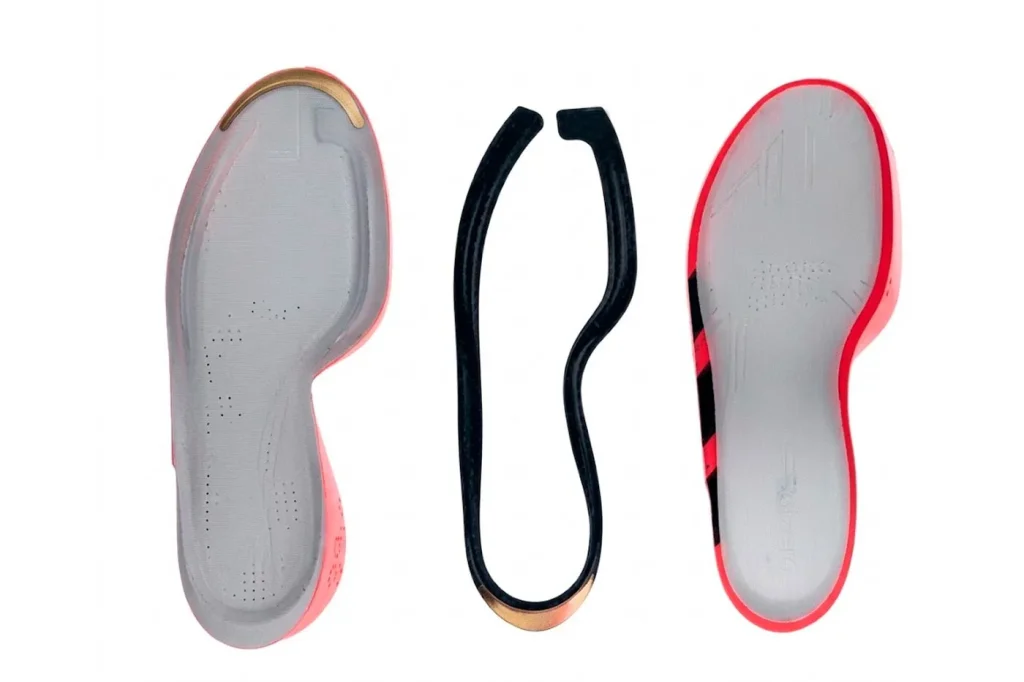
The defect is two-fold. First, the Continental™ rubber coverage was aggressively dialed back under the Lighttraxion layout, leaving low-tensile supercritical foam exposed to raw asphalt friction. But one more controversial design choice lies in the physical placement of the carbon rim itself: the rigid edge of the carbon chassis sits completely exposed along the lateral flanks of the midsole.
Biomechanical Conflict: The Exposed Carbon Anvil
An open visual cutout designed to visibly showcase the new carbon technology to consumers on retail shelves, creating an aggressive, high-tech aesthetic silhouette.
Skipped rigorous testing with amateur runners. Athletes who cross their legs under late-race fatigue report the rigid carbon rim acting like a blunt blade, causing lacerations and bruising on the medial malleolus of the opposing ankle.
3. Diving Further: The “Compromised” Mid-Tier
Digging deeper into collective wear-testing reveals that this durability crisis could be merely a symptom of a broader structural realignment. The conversation among footwear analysts / enthusiasts is starting to ask if the traditional flagship super shoe has been deliberately compromised.
For years, purchasing an Adios Pro or a Nike Alphafly meant securing the absolute pinnacle of that corporation’s research, chemistry, and tooling. It was the exact footwear claiming podiums at Berlin and London. That era is over.
The Adios Pro 5 has been engineered into a commercial halfway house. Instead of a homogeneous block of bleeding-edge foam, Adidas implemented an asymmetrical dual-foam layout: slapping a layer of the premium PEBA compound derived from their ultra-exclusive Evo series over the carrier foam (from the Pro 4?). It represents a watered-down experience masquerading as an apex racer, sold at a historic premium price point.
Clearly, the foam used to set the marathon record has chemical and mechanical properties that render it unsuitable for consumer shoes (i.e. it lacks an external wall due to milling rather than moulding).
4. The Physical “Enshittification” of Elite Running
This calculated downgrade is a textbook manifestation of “enshittification”—a concept popularized by author Cory Doctorow to describe how digital platforms systematically degrade user experience and claw back value once they possess a captive audience.
The Three Stages of Running Footwear Enshittification:
- Phase 1 (The Hook): Brands develop revolutionary, highly durable disruptors like the Adios Pro 3—a shoe runners routinely squeeze 500+ kilometers out of with zero structural delamination. Extreme consumer loyalty is secured.
- Phase 2 (The Clawback): Once the consumer base is locked in, manufacturers pivot to margin optimization. They reduce compound lifespans, cut protective outsole rubber, and release incremental geometry tweaks marketed as breakthroughs.
- Phase 3 (The Paywall): True, uncompromised R&D is stripped out of the core $250 line and sequestered behind a new, hyper-inflated luxury tier ($450–$500), forcing consumers to accept degraded quality at legacy prices.
EDITORIAL NOTE:
-
What started as a malicious tactic used mainly in online business has spread through services and reached consumer goods in recent years. Physical products are being removed from consumers’ hands — that is, their property is being taken away — in order to evolve into a pay-per-use model.
- Independent Video Teardown: Watch the full investigative breakdown on the FORDY RUNS YouTube Channel.
- Community Wear-Testing Megathread: Track user reports, sole-peeling photos, and batch discussions on Reddit’s r/RunningShoeGeeks.
- Elite Racing Gear Threads: Follow verified marathon major shoe counts and durability debates on the LetsRun Shoe & Gear Message Board.
- Official Specifications: Compare legacy architecture with current models via the Adidas Adizero Performance Hub.
5. The Two-Tier Strategy: The $500 Paywall
Nike is playing the exact same playbook. The Nike Alphafly 4 arrived with conservative, risk-averse changes: a slightly wider base for stability, minor revisions to the Air Zoom pods, and a layer of ZoomX LT foam. It is an evolutionary update engineered specifically not to disrupt sales. Why? Because both industry titans are reserving their true, unconstrained innovations for an entirely new price bracket: the Ultra-Premium Halo Tier.
If you demand the absolute best, uncompromised technology—pure, ultra-low density supercritical foams and unrestricted composite layups—you are now funneled toward models like the Adidas Adizero Adios Pro Evo 3 or the Nike Alphafly Apex. These platforms sit behind an astronomical paywall of $450 to $500.
The strategy is transparent: reclassify the $260–$300 super shoes into a “middle-class” training tier, force everyday athletes to tolerate compromised durability, and charge historic premiums for what used to be the democratic standard. The Adios Pro 5 durability crisis is the exact moment the running community realized that the venture-capital playbook had conquered the marathon.

How FORDY RUNS Called Out the Tech-Rationing Pivot
While online communities were busy debating isolated photos of torn foam, veteran footwear reviewer FORDY RUNS blew the whistle on the structural shift behind the curtain. In his head-to-head race-shoe selection analysis for the Amsterdam Marathon, he diagnosed the precise corporate pivot altering the rules of the sport.
By openly branding the Pro 5 as a “compromised” shoe, FORDY RUNS pierced the marketing smoke and mirrors. He warned runners that the uncompromised flagship status historically carried by the $250 shelf is dead. By exposing how Adidas watered down the Pro 5 into a hybrid halfway product—borrowing fractional tech from the Evo line while locking pure compounds away—his review served as a critical public warning to the everyday marathoner.
💡 Reference: FORDY RUNS Road-Test Breakdown & Amsterdam Marathon Selection Guide.
The 2026 Carbon-Plated Market Segmentation
| Market Category | Flagship Models | Technological Blueprint | Corporate Compromise | Durability & Field Reality |
|---|---|---|---|---|
| Tier 1 Ultra-Premium (Halo Tier) | Adidas Pro Evo 3 / Nike Alphafly Apex | Uncompromised, pure elite compounds; maximum compliant stack heights. | Priced astronomically ($450+) to extract maximum revenue from affluent buyers. | Strictly optimized for single-race performance; structural lifespan is secondary. |
| Tier 2 Commercial Super Shoes | Adidas Adios Pro 5 / Nike Alphafly 4 | Hybrid foam layups; incremental geometric shifts; dual-density carriers. | Watered down to protect halo tier; retains legacy pricing ($260–$300). | Highly volatile; exposed elements and aesthetic gimmicks lead to premature wear. |
| Tier 3 Plated Performance Trainers | Adidas Boston Series / Nike Zoom Fly Series | Standard resilient EVA/TPU blends; glass-fiber or heavy composite plates. | Built heavy and stiff to ensure a clear performance gap below the racing tier. | High longevity; thick rubber outsoles engineered to endure hundreds of training miles. |
Mr Bürung
A specialist in macromolecular mechanics, Mr Bürung graduated with a Bachelor of Engineering in Biomedical Engineering before completing his Master of Science in Materials Science and Chemical Engineering. His post-graduate research was concentrated on the rheological characterisation of microcellular porous polymers and the thermodynamic phase-separation dynamics of supercritical fluids (SCF).
With over a decade of technical tenure dedicated to the structural design, tooling verification, and mechanical stress-testing of alpine ski and extreme high-altitude mountaineering boots, he consulted extensively for several tier-one manufacturers within Italy’s prestigious Montebelluna footwear engineering cluster. Prior to his retirement, he served as an advanced manufacturing and tooling adviser across applied research institutes and specialised polymer compounding facilities, overseeing automated OEM/ODM injection nodes situated throughout the Klang Valley and Johor industrial corridors in Malaysia.