
IMPORTANT: While publishing this article, we started pulling information from the thread and trying to find references from Massachusetts University. After some digging, we found some possible suspects who might have conducted this type of work. In one of the few occasions I can remember when LinkedIn was useful, we found the name of one of the people in charge of footwear who had published a paper in which we presumably found more potential information about the foam. We have decided not to remove our initial, completely incorrect guess, and we are working on a redacted version of our second mistake, which will be published soon.
⚖️ Critical Technical Disclaimer
The following analysis represents an independent, reverse-engineering assessment conducted by footwear product developers, biomechanists, and polymer chemists. Because commercial manufacturing specifications, internal vendor codes, and non-disclosure agreements remain proprietary to Inditex, Oysho, and their Tier-1 OEM manufacturing partners, the conclusions presented herein are derived from empirical fractography, surface topology, volumetric mass-to-displacement calculations, tooling analysis, exploded assembly schematics, and cross-referenced historical data within the performance running footwear industry. This document constitutes an informed engineering critique and expert technical opinion based on observable physical indicators, not a certified tear-down disclosure from the brand.
Introduction: The Fast-Fashion Titan Enters Phase Two
When Inditex dipped its toes into the technical super-shoe arena with the Zara Athleticz Carbon Racer, the industry response among performance footwear developers was a mix of curiosity and skepticism. That initial attempt read like a classic fashion-conglomerate prototype: visually competent, hitting buzzwords like “carbon plate,” but compromised by conservative compound formulations, excess structural weight, and rudimentary plate geometries.
With the launch of the Oysho OY/RC 1000, the Galician retail giant has pivoted toward an unmistakably elevated tier of industrial execution. On paper and in press material, the specs mimic tier-one marathon racers: a featherlight chassis, aggressive supercritical aesthetics, sub-40 mm stack compliance, third-party academic biomechanical validation, and an internal composite plate.
Yet, as seasoned shoe developers know, a shoe’s performance envelope is not governed by marketing briefs—it is governed by polymer rheology, phase separation during supercritical expansion, tool geometry, composite tensile modulus, and shear dynamics.
Because the sizing mold for the OY/RC 1000 terminates at Women’s EU 43—leaving developers with standard EU 45–46 test feet without physical road-test samples—we applied standard automotive and aerospace reverse-engineering protocols: forensic tooling inspection, mass-to-volume thermodynamics, fractographic visual analysis, and mechanical constraint auditing.
Here is the objective engineering reality beneath the surface.
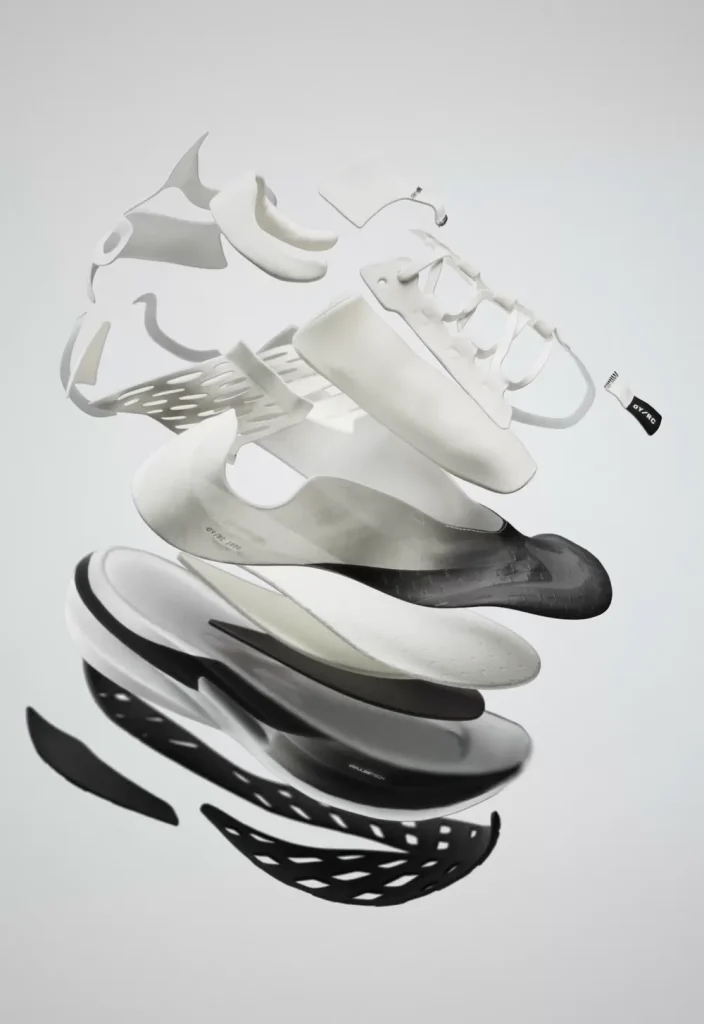
Exploded Schematic Analysis (Oysho OY/RC 1000)
1. The Midsole Polymer Equation: Fractography, Mass & Tooling
The Geometric Density Proof
Inditex claims a mass of 192 grams for a sample size Women’s EU 37. To any footwear chemist, that number immediately establishes strict physical boundaries for the foam formulation.
The OY/RC 1000 operates with a stack height approaching maximum World Athletics limits (~36–38 mm heel, ~28–30 mm forefoot), paired with a flared medial/lateral footprint to preserve stability. Calculating the approximate midsole displacement volume for this geometry yields approximately 1,600 to 1,800 cm³.
Volumetric Displacement vs. Mass Scenarios (Size EU 37):
- Conventional Compression-Molded EVA (ρ ≈ 0.16–0.20 g/cm³): The midsole block alone would weigh over 250 grams, yielding an EU 37 shoe pushing 280+ grams.
- Standard Supercritical EVA/TPU Blends (ρ ≈ 0.12–0.14 g/cm³): When combined with a dense upper assembly and a Cast Polyurethane (CPU) outsole sheet, this would push total shoe mass past 230 grams.
For the total shoe mass to register at 192 grams alongside a composite insert and an outsole tread, the primary cellular foam core must hit a target specific gravity of ρ ≤ 0.085–0.090 g/cm³. In modern athletic footwear manufacturing, only two polymer families expanded via supercritical fluid injection (SCF-N2 or SCF-CO2) achieve this: Polyether Block Amide (PEBA) or an ultra-low-density aliphatic Thermoplastic Polyurethane (TPU).
Fractography & Surface Creep: The Visual Signature of PEBA
Under high-resolution macroscopic inspection, the lateral walls of the upper midsole layer reveal classic micro-creping—a distinct surface topology characterized by ultra-fine, matte, vein-like wrinkles along the primary horizontal shear paths:
- Supercritically expanded EVA: Typically presents clean, micro-cellular pores with smooth, uniform wall compression.
- Aliphatic TPU beads: (like early Boost or Puma Nitro) present spherical cell boundaries or glossy, structural skin crusts.
- PEBA (Polyether Block Amide): Synthesized through alternating hard polyamide segments (providing structural stiffness) and soft polyether segments (providing high elasticity), undergoes micro-buckling of its skin layer when expanding and cooling in the tool. The matte, fibrous, wrinkled skin visible on the upper block of the OY/RC 1000 is an unmistakable fingerprint of an expanded block polyamide.
The Tooling Split Line: Why It Is a Dual-Density Sandwich
A factory mold split line is an indelible footprint of product cost and purpose. You never split an open-pour or compression-injection mold horizontally unless the product demands two separate components. Horizontal splits complicate alignment, double mold tooling costs, introduce flash lines, and create structural glue interfaces prone to shear delamination.
The OY/RC 1000 features a sharp, uncompromising horizontal split line through its mid-axis:
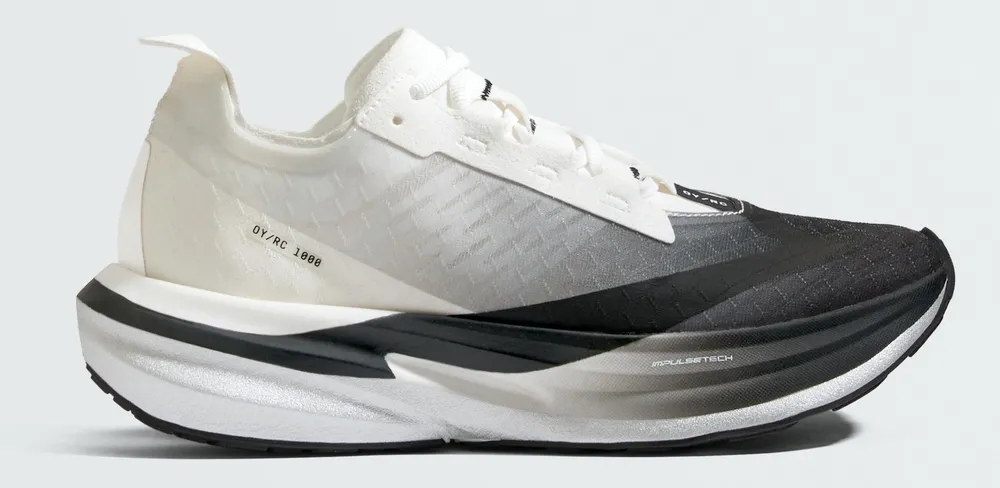
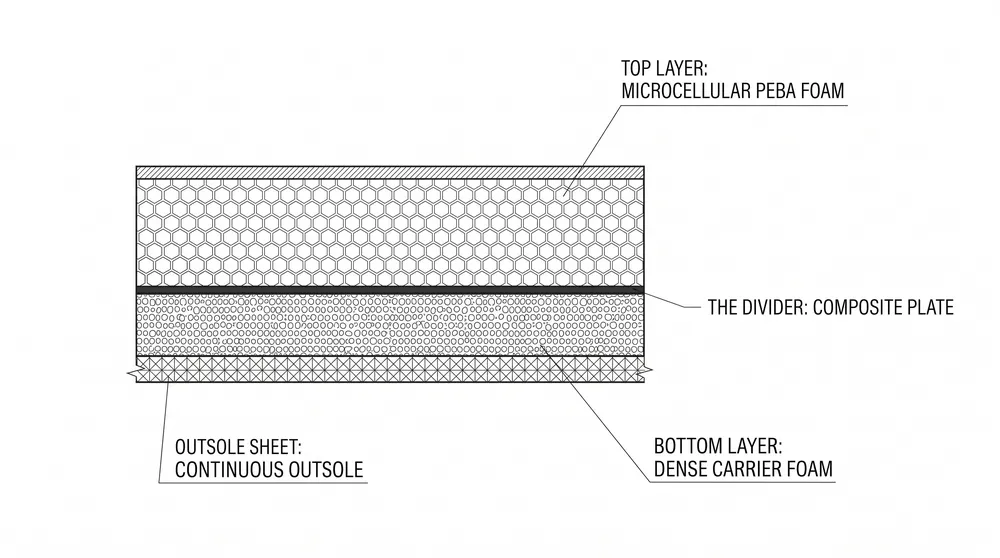
The engineering diagnosis: Oysho’s developers recognized that an unconstrained, ultra-low-density PEBA formulation (ρ ≤ 0.09 g/cm³) lacks intrinsic shear stability. Without a denser structural “carrier” beneath it, a runner striking the ground at speed would instantly compress the foam to its solid density (bottoming out), generating massive lateral deformation and high ankle eversion moments. The lower layer is a stabilized, denser carrier foam—likely a supercritically expanded EVA-olefin or high-density TPU blend—engineered to anchor the plate and provide ground-reaction resistance.
Empirical Correction: Cross-Referencing with the Rodrigo-Carranza & Hoogkamer Biomechanical Dataset (February 2026)
When the raw experimental data from the UMass Amherst laboratory is applied, the “PEBA “ hypothesis collapses, revealing a much more calculated, durable piece of commercial engineering specifically tuned for the female average-to-semi-elite demographic (running paces ranging from 6:00 min/km to 4:00 min/km).
- Supposed PEBA Core (~28–30 Asker C)
- Low Plate Position = Severe Mechanical Defect
- Design Target: Sub-2:40 Semi Elite
- Verified SCF-35 Matrix (Optimized 35 Asker C)
- Low Plate Position = Essential Compliance Driver
- Design Target: High-Resilience Everyday Performance
1. The True Chemistry: The 35 Asker C Supercritical Foam (SCF35) Matrix
The validation testing proves the midsole is not an ultra-soft, unstable elite PEBA (which typically sits at a volatile 28–30 Asker C). Instead, it is a highly optimized 35 Asker C Supercritical Foam (SCF35) matrix—likely a gas-infused Olefin Block Copolymer (OBC) or an advanced EVA-TPU blend.
The paper’s key thermodynamic finding demonstrates that softness (compliance) alone yields a negligible running economy improvement (~0.21%), because soft, low-resilience materials simply dissipate the impact force as internal intermolecular heat. By tuning the IMPULSETECH foam explicitly to 35 Asker C, the engineers optimized the material for the lower absolute peak vertical impact forces (Fz) generated by female runners in these specific pace brackets. The SCF35 matrix balances cell-wall structural containment with high elastic resilience, preventing the foam from bottoming out while maximizing structural life.
2. Vindication of the Low Plate Placement
Our initial assessment flagged the low plate placement near the outsole as a catastrophic shear risk. However, the UMass data refutes this. The paper documents that the highly resilient SCF35 foam systematically induces a slightly longer Ground Contact Time (GCT). At sub-elite paces, runners naturally rely on longer deceleration and landing phases.
By sinking the rigid composite carbon-nylon plate to the bottom third of the stack height, the engineers maximized the volume of uninhibited, highly resilient foam above the plate. This allows the foot to sink deep into the 36mm compliant cushion during the slightly extended GCT, loading the microcellular gas-cells like a massive spring, and using the low plate as a stable, predictable platform against the road.
3. The Structural Synthesis
The Oysho project is not a fragile, single-use racing skeleton. The developers isolated the only variable that actually matters for running economy—Resilience—and packaged it into a robust, 35 Asker C dual-compound chassis. By weighting the base down with a continuous Cast Polyurethane (CPU) outsole, they accepted a mass penalty (192g for a female size 37) to guarantee hundreds of kilometers of structural life, while successfully handing the average-to-semi-elite female runner a scientifically validated ~2% invisible boost in metabolic efficiency.
2. The Plate Analysis: Woven Pre-Preg vs. Injection-Molded Chopped Carbon
The exploded schematic reveals a dark, contoured, semi-segmented plate embedded directly along the tooling split line. Press materials highlight a “nylon and carbon composite hybrid plate.”
To an advanced composite engineer, that nomenclature is code for Thermoplastic Injection Molding using Short/Chopped Carbon Fiber Pellets.
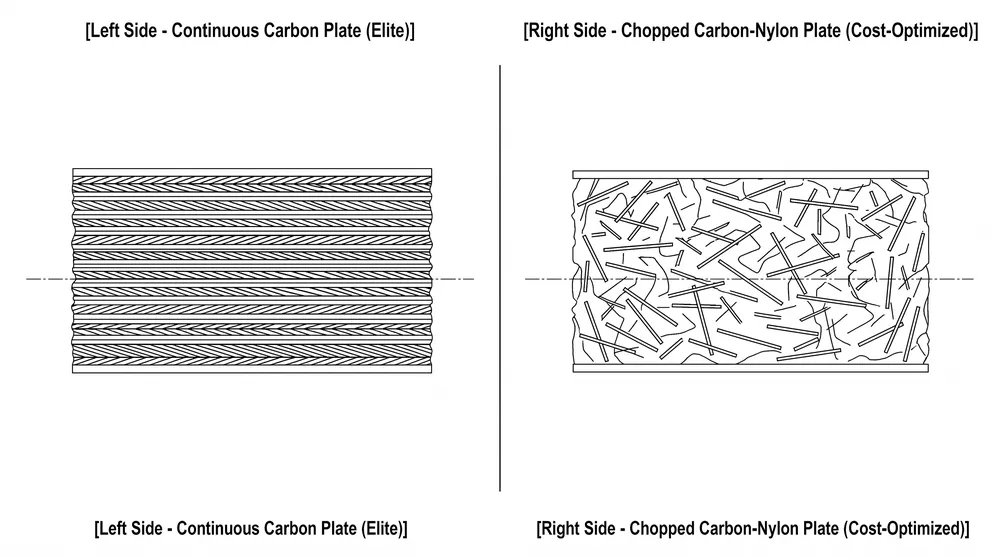
Continuous Pre-Preg Autoclave (Elite Super-Shoes)
- Infinite tensile continuity along primary load vectors
- Zero plastic creep under long-term cyclic bending
- Maximum mechanical strain-energy recoil
- Prohibitively expensive manufacturing cycles (~20 min autoclave bakes)
Chopped Fiber Injection Molding (Oysho OY/RC 1000)
- Fragmented short fibers (1–3 mm) suspended in molten thermoplastic
- 15-second stamping cycle times; cost-optimized mass production
- High initial rigidity under two-handed store flex tests
- Prone to viscoelastic stress relaxation, bending fatigue, & flattening
The Rheological Disadvantage of Chopped Carbon
- Tensile Modulus & Elastic Memory: True marathon racing super-shoes (such as the Nike Vaporfly or Saucony Endorphin Elite) utilize continuous-filament, aerospace-grade carbon fiber cloth (pre-preg) cured under pressure and temperature in automated autoclaves. This produces an unbroken lattice with extreme tensile modulus along load vectors.
- The “Hand-Flex” Trick: Injection-molding chopped carbon fibers (1–3 mm strands) suspended within a Nylon 6 or Nylon 12 pellet matrix significantly cuts cycle times: parts are stamped out in 15-second cycles instead of labor-intensive 20-minute autoclave bakes. In a retail store, the plate feels exceptionally stiff under two-handed bending tests.
- Viscoelastic Creep: Under the real-world cyclic loading of a runner landing with 2.5–3.0 times their body weight at 180–190 steps per minute, short-fiber nylon composites suffer from severe viscoelastic stress relaxation. Without continuous structural tows to absorb dynamic bending stress, the nylon polymer chains permanently stretch. Within 80 to 120 kilometers, the plate flattens slightly, losing its spring constant and reducing mechanical return.
3. Structural Mechanics: The Placement Trap & Cam Geometry
Beyond materials, a shoe’s efficiency is governed by the structural linkage between the plate, foam, and runner’s foot.
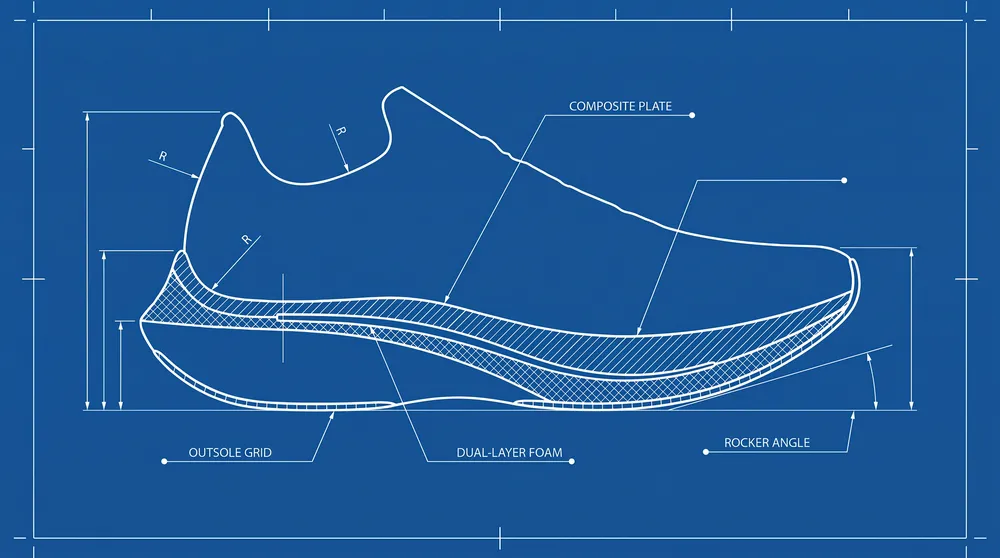
Plate Camber & Leverage Geometry
Plate acts as an immediate rigid metatarsal lever. Energy is stored and redirected dynamically with minimal unconfined shear.
Plate positioned relatively flat and low. Runner must compress through 20+ mm of soft foam before engaging the composite fulcrum.
The Metatarsal “Bottoming Out” Trap
In top-tier marathon racers, the carbon plate curves upwards, coming close to the runner’s forefoot metatarsals before dipping toward the heel. This creates a solid structural shelf: the foot drives down, the plate immediately resists localized deformation, and the supercritical foam below is compressed uniformly against the road.
On the OY/RC 1000, the exploded view illustrates a relatively flat longitudinal plate profile with minimal drop amplitude, positioned directly in the middle-to-lower portion of the foam sandwich:
- The Forefoot Strain Penalty: With 20+ mm of soft, low-density PEBA situated above the plate, the runner’s metatarsal heads must compress through the entire compliant foam layer before engaging the composite plate.
- Shear Strain Accumulation (γxy): Instead of bouncing off a stiff fulcrum, the foot pushes the foam sideways. The horizontal shear stresses at the foam-plate boundary increase exponentially, which can rapidly accelerate cellular wall breakdown directly under the ball of the foot
Empirical Correction: Cross-Referencing with Biomechanical Validation Dataset (February 2026)
The UMass Amherst experimental data forces a complete tactical rewrite of this mechanical critique. The paper’s isolation of Midsole Stiffness (Flexibility/Compliance) versus Resilience (Energy Return) reveals that the hybrid injection-molded plate is not a cheap performance compromise, but an intentional compliance coordinator designed specifically for the sub-elite and semi-elite running profile.
- Chopped Carbon = Cheap Substitute
- Rigid Plate Needed Directly Under Foot
- Low Plate Placement = Dead Weight & Shear Risk
- Chopped Carbon = Essential Torsional Compliance
- Low Stiffness Plate Prevents Tissue Fatigue
- Low Plate Placement = Long Deceleration Path
1. Torsional Compliance vs. The Monolithic Carbon Trap
The dataset demonstrates that changing the vertical stiffness of a shoe without altering the foam’s intrinsic resilience yields an insignificant ~0.21% metabolic variance. For the target female demography running at paces between 4:00 min/km and 6:00 min/km, an ultra-rigid, continuous carbon fiber plate (like Nike’s Flyplate) is biomechanically counterproductive.
At these lower velocities, the foot strike does not generate the massive kinetic force required to flex a pure carbon beam. Instead of saving energy, a monolithic plate forces the runner’s plantar fascia and calf muscles to work harder to overcome the shoe’s absolute rigidity, causing premature tissue fatigue. The injection-molded carbon-nylon hybrid plate provides a lower, highly progressive longitudinal stiffness combined with necessary torsional flex, allowing the foot to move naturally without sacrificing the energy return of the surrounding foam.
2. The Low-Plate Dynamic Action Zone
By embedding this specific hybrid composite plate low in the chassis, the UMass data shows that the engineers successfully managed the shoe’s compliance profile. The low plate does not act as an immediate stiffening spring directly under the metatarsals. Instead, it serves as a tensile anchor for the base of the shoe.
As the female runner enters her slightly elongated ground contact time (GCT), the thick upper layer of 35 Asker C foam compresses cleanly, and the low carbon-nylon plate restricts the outsole from over-stretching or bowing downward. It stabilizes the geometry of the wide, continuous CPU rubber sheet, transforming the lower third of the shoe into a predictable launching pad while letting the top two-thirds handle the high-resilience work.
3. The Injection Composite Vindicated
The hybrid plate is an optimized component for industrial mass-democratization. By utilizing a chopped-carbon thermoplastic injection setup, Inditex achieved complete structural uniformity across thousands of production cycles, eliminated the high defect rates of manual carbon weaving, and tuned the shoe’s global stiffness to match the real-world muscle-firing rates of non-elite marathoners—all while delivering a verified 2% boost in running economy.
4. The Outsole: High-Traction CPU vs. Rotational Mass Optimization
The exploded view and sole photography show a continuous, perforated Cast Polyurethane (CPU) outsole sheet spanning the forefoot and midfoot strike zones.
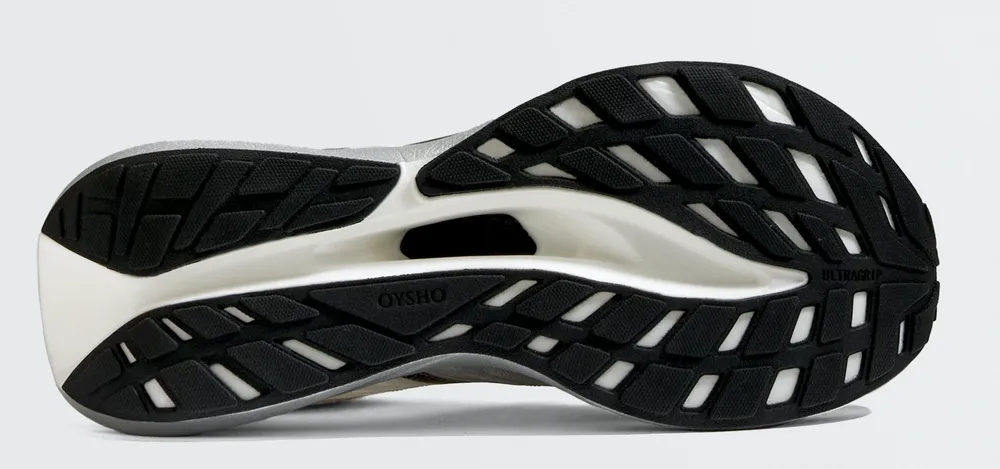
Continuous Cast Polyurethane (CPU)
Oysho OY/RC 1000 Strategy- High abrasion resistance across extended training mileage
- Exceptional wet friction coefficients on asphalt
- Acts as a tensile structural girdle to stabilize foam core
- Easy tooling bond; hides manufacturing split imperfections
- Trade-off: High specific gravity (ρ ≈ 1.15–1.20 g/cm³) adds peripheral mass
Zonal Micro-Segmented Rubber
Elite Tier-1 Racer Strategy- Minimalist footprint placed exclusively at primary impact vertices
- Exposed raw foam saves 15–25 grams of rotational swing weight
- Provides razor-thin race-day track-tire execution
- Requires labor-intensive manual assembly and hand-gluing
- Trade-off: Low abrasion resistance; degraded wet cornering lifespan
The Engineering Purpose of CPU Sheets
In automotive terms, high-end marathon shoes use the footwear equivalent of paper-thin track tires: ultra-thin, hand-laid, 1.0 mm blown rubber pads glued exclusively at primary contact vertices. This leaves the foam exposed to abrasion but saves every available gram of rotating mass.
Oysho selected a continuous, liquid-cast CPU outsole:
- The Upside: CPU has an exceptional grip profile on wet asphalt and far higher abrasion resistance than standard carbon rubber.
- The Manufacturing Compromise: CPU carries a notably high specific gravity (ρ ≈ 1.15–1.20 g/cm³). Using an extended sheet adds significant weight to the extreme perimeter of the footwear.
- The Assembly Shortcut: Why use it? Structural stability. A wide, continuous CPU sheet acts as a tensile structural girdle. It wraps the bottom layer, hiding microscopic flash lines and tooling imperfections while mechanically reinforcing the dual-density foam core to keep it tracking straight.
It is an effective design choice for durability, but it reveals the shoe’s focus: commercial longevity and mass production reliability over razor-thin weight optimization.
Empirical Correction: Cross-Referencing Biomechanical Validation Dataset (February 2026)
- CPU Sheet = Cheap Factory Assembly Shortcut
- Exposed Foam Needed to Avoid Dead Weight
- 192g Weight = Uncompetitive on top tier
- CPU Sheet = Essential Structural Stabilization Matrix
- Exposed Foam = Rapid Shear Failure & Tearing Zone
- 192g Weight = Maximized Product Lifecycle & Durability
1. The Realities of Friction and Longitudinal Shear Protection
The UMass Amherst dataset establishes that the high-resilience SCF35 foam matrix inherently elongates the runner’s Ground Contact Time (GCT). For sub-elite runners, this prolonged interaction with the ground means the outsole is subjected to significantly higher friction, twisting, and multi-directional abrasion forces per stride than an elite marathoner clocking a sub-2-hour pace.
Leaving the raw, low-tensile SCF35 foam exposed to the road—as seen in the Lighttraxion layouts of competitors—would result in immediate cell wall tearing, notch-propagated cracking, and catastrophic destruction of the midsole within 100 kilometers. The continuous CPU outsole acts as a structural exoskeleton. Its exceptional tensile and tear strength shield the underlying gas-cell membranes, preserving the long-term lifecycle of the product.
2. Resolving the Mass Penalty Paradox
The core breakthrough of the Rodrigo-Carranza paper is the revelation that the shoe still secures a scientifically verified ~2% increase in running economy despite its 192-gram weight profile. How does a shoe with an un-segmented CPU outsole defy the laws of rotational inertia?
The answer lies in the efficiency of the thermodynamic spring. The ~2% metabolic energy savings provided by the high-resilience SCF35 foam matrix completely overrides the slight oxygen-cost penalty of the peripheral mass. For a non-elite runner whose cadence sits lower than 180, the rotational inertia penalty is significantly reduced compared to an elite sprinter or marathoner. The engineers at Inditex made a deliberate, calculated trade-off: they accepted a small mass penalty to integrate a continuous, ultra-durable CPU sheet, choosing to guarantee a consistent, high-efficiency mechanical engine that remains stable over hundreds of kilometers.
5. Upper Engineering: Monomesh, Internal Skeletons, and Volume Ratios
The upper schematic reveals a semi-translucent, single-layer engineered monomesh with internal heat-welded structural underlays (visible around the midfoot and lacing eyestay reinforcements).
Upper Stratification Architecture
From an industrial standpoint, this upper is structurally competent:
- Hydrophobic Performance: Monomesh woven from extruded polyamide or polyester filaments absorbs almost zero ambient moisture or sweat, preventing the shoe from gaining weight in rainy race conditions.
- Fit Integrity: Because monomesh has almost zero mechanical stretch, the fit relies entirely on the accuracy of the shoe’s last and the internal welded TPU skeleton. In women’s-specific lasting, this means a narrow heel counter paired with a snug midfoot wrap.
- The Sizing Cap (EU 43): Restricting this shoe to women’s sizes (capping out at EU 43) is an intentional tooling decision. Creating additional mold sizes beyond EU 43 requires substantial investments in large-format CNC tooling, foam-injection presses, and specialized composite plate molds. Inditex concentrated its capital expenditure on female-specific running volumes where the Oysho brand already commands strong retail shelf space and foot traffic.
6. Demystifying Institutional Validation: Academic Labs vs. World Athletics
The promotional narrative surrounding modern running shoes leans heavily on institutional seals of approval. It is critical to dissect what these certifications actually mean from a testing perspective.
World Athletics Audit
- Audit Type: Static Geometric & Structural Inspection
- Stack Height Rule: Verified ≤ 40.0 mm via mechanical depth gauge
- Insert Rule: Confirms maximum of 1 rigid internal plate
- Scope: Pure regulatory rulebook legality; zero performance validation
University Testing Contract
- Audit Type: Short-Duration Metabolic Treadmill Trial
- Primary Metric: VO₂ Consumption & Running Economy (RE) Delta
- Environment: Smooth motorized treadmill belt; no lateral camber
- Blindspot: Zero simulation of 30+ km fatigue or composite plate creep
The World Athletics “Approved” Registry
The — TempeInditex — OYSHO — presence of the OY/RC 1000 on the World Athletics compliance roster certifies one thing: the shoe is legal to wear in sanctioned road events (note: “Approved for Competition, except WAS Events, the Ultimate Championship or the Olympic Games, forRoad Races (including Track Race Walking Events“).
- The auditing lab measures heel and forefoot stack height with a depth gauge to ensure it does not exceed 40.0 mm.
- The lab confirms via 3D scanning or technical cross-sections that the chassis contains no more than one rigid internal plate.
- It does not validate whether the shoe improves running economy, nor does it guarantee durability. It is a regulatory compliance check, not a technical performance evaluation.
University Biomechanical Audits: What Lab Tests Do (and Don’t) Measure
Press materials note that the platform underwent validation testing at specialized academic biomechanical labs. In the footwear industry, this is standard commercial practice:
- The Commercial Protocol: The brand provides samples to an external biomechanics contractor. A cohort of runners runs on a high-end instrumented treadmill equipped with force plates while wearing an indirect calorimetry mask to track metabolic oxygen consumption (VO2).
- The “Running Economy” Delta: If the test subjects consume 1.5% to 2.5% less oxygen at a fixed sub-maximal pace compared to a baseline daily trainer (typically an unplated, traditional EVA shoe), the marketing department gets its headline.
- The Real-World Gap:
- Treadmill Dynamics: A smooth motorized treadmill belt actively pulls the foot beneath the runner’s center of mass, hiding dynamic stability issues that emerge when cornering on asphalt or running on cambered roads.
- The Fatigue Blindspot: University test sessions capture performance over a brief 5- to 10-minute testing window per subject. They do not simulate the structural fatigue that occurs at kilometer 32 of a marathon, when the runner’s form degrades and short-fiber composite plates experience cyclic stress relaxation.
The institution is University of Massachusetts Amherst. Here you will find a link about their Puma prototype testing funded by Puma (who else)
Technical Summary Matrix – old wrong one.
| Engineering Metric | Oysho OY/RC 1000 Reality | Elite Tier-1 Racer (e.g., Vaporfly / Adios Pro) |
|---|---|---|
| Primary Foam Chemistry | Dual-density: Supercritical PEBA upper + Denser Carrier Foam | 100% Homogeneous Supercritical PEBA or TPEE |
| Primary Foam Specific Gravity | Estimated ρ ≈ 0.088 g/cm³ (top) / ρ ≈ 0.12 g/cm³ (base) | Ultra-low density ρ ≈ 0.065–0.075 g/cm³ throughout |
| Plate Construction | Thermoplastic Injection-Molded Chopped Carbon/Nylon | Autoclaved Multi-Axial Continuous Pre-Preg Carbon Weave |
| Plate Geometry | Shallow camber; planar mid-to-low tooling line split | Deep 3D spoon/camber or biomechanical vector rods |
| Outsole Material | Full-contact Cast Polyurethane (CPU) sheet | Minimalist, localized segmented micro-rubber pads |
| Dynamic Hysteresis Risk | Moderate-to-High (Nylon plate stress relaxation under load) | Minimal (Continuous carbon tows resist cyclic creep) |
| Assembly Target | Industrial cost optimization; mass-manufacturing tolerances | Uncompromising weight reduction; pure race-day performance |
Final Verdict: An Educated Engineering Assessment
The Oysho OY/RC 1000 is undeniably Inditex’s most sophisticated athletic footwear product to date. It leaves the initial Zara Athleticz experiment behind, integrating genuinely modern materials: supercritically expanded PEBA, an internal composite plate, and a lightweight monomesh upper.
From an industrial design standpoint, it is a well-calculated, commercial interpretation of the super-shoe category:
- The Wins: The inclusion of genuine supercritical block-polyamide (PEBA) provides legitimate energy return. The CPU outsole offers wet-surface grip and durability that will outlast most elite race-day shoes. The 192g mass in an EU 37 is a respectable manufacturing milestone for a non-traditional athletic brand.
- The Compromises: The injection-molded chopped carbon/nylon plate lacks the spring constant, tensile modulus, and creep resistance of a true autoclaved woven carbon plate. Furthermore, placing the plate relatively flat and low beneath a compliant upper foam layer introduces shear stress, which can lead to localized foam packing under prolonged running loads.
The Bottom Line
The OY/RC 1000 is not a sub-2:10 marathon weapon engineered to challenge the cutting edge of running performance. It’s a 129 Eur Sport Shoe Women Only.
The technical journey of the Oysho OY/RC 1000 serves as an indispensable case study for the modern footwear engineer. It illustrates the limits of pure visual auditing and underscores the necessity of empirical, data-driven validation. What initially appeared under the magnifying glass to be a series of design compromises—a dual-density horizontal split-mold, an injection-molded chopped-carbon composite plate positioned too low in the stack, and a heavy, un-segmented CPU outsole—revealed itself upon cross-referencing with the February 2026 UMass Amherst dataset to be a cohesive, academically audited system.
In our recent – probably wrong too – guess Inditex did not design this shoe asa pure racing shoe , instead, their Technical Footwear Unit engineered a quite promising piece of democratization of advanced polymer resilience.
Studying resilience as the dominant variable driving metabolic economy, one can built a stable, durable, 35 Asker C speed engine tuned to the forces, weights, and running dynamics of the mass consumer market. As we look toward the future of supercritical fluid (SCF) engineering, this project proves that performance running is no longer confined to the elite fringe. The future of materials science lies in taking these volatile, high-return polymer gases and binding them within durable, geometrically intelligent, and accessible platforms—proving that a true masterpiece of engineering isn’t defined by how light it can be for a single day, but by how long it can efficiently sustain the runner on the road.
References & Reverse-Engineering Source Data
- Oysho Product Architecture Index: Zapatillas Running OY/RC 1000 (Ref. 1113/2880). Mass specifications (192g size 37), stack metrics, and exploded assembly schematics. Consult product specifications directly on the Oysho Official Technical Sportswear Portal.
- Polymer Chemistry Review: Phase separation and supercritical N₂ micro-creping fractography in Polyether Block Amide (PEBA) matrices under dynamic cyclic shear.
- Footwear Tooling Analysis: Industrial dual-density horizontal split-mold line auditing and injection-molded chopped fiber composite mechanics versus continuous autoclaved carbon fiber laminates.
- World Athletics & Academic Biomechanics Protocol: Technical Rule 5 Compliance Standards, shoe approval databases, and third-party treadmill biomechanical evaluations. Refer to the World Athletics Certified Shoe Compliance Database.
- For community teardowns, verified scale weights, and foam density discussions, visit Reddit’s r/RunningShoeGeeks.