
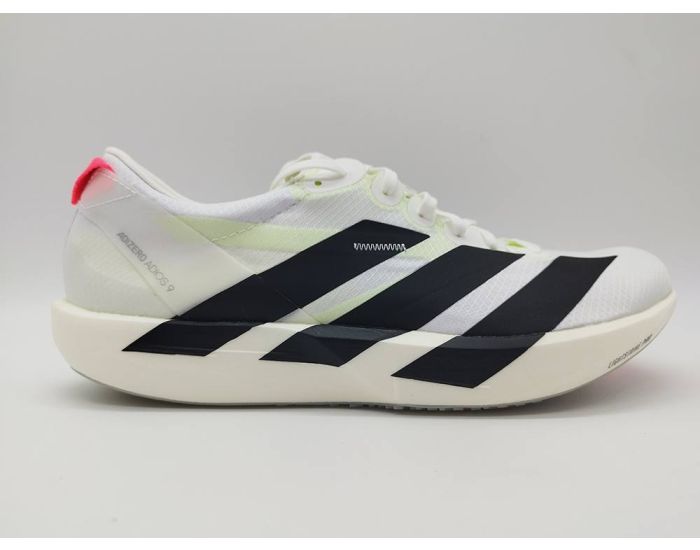
Full Lightstrike Pro foam, 176 grams of pure speed, and the soul of a classic racing flat. The Adios 9 proves you don’t need carbon fiber to fly — just Japanese craftsmanship and 20 years of marathon history.
The Quick Take
The Adidas Adizero Adios 9 is a love letter to old-school racing flats, rebuilt for 2025 with the same premium Lightstrike Pro foam found in the $250 Adios Pro 4. At just 176 grams with a ground-hugging 28mm stack height, this is the most accessible way to experience Adidas’s superfoam technology. Perfect for tempo runs, track workouts, and runners who still believe speed comes from your feet, not a carbon plate.
Best for: Tempo runs, intervals, track sessions, 5K-10K races, and training alongside the Adios Pro 4
Skip if: You need maximum stability, prefer plush cushioning, or are a beginner building speedwork fitness
A Japanese Legacy: From Haile to 2025
The Adios story begins with a Japanese artisan. Like the legendary Takumi Sen, the Adios line was shaped by Toshiaki Omori, a designer who has crafted running shoes for Adidas since 1999 using a philosophy he calls “inside-out.” Rather than starting with digital molds, Omori took physical casts of elite runners’ feet, building shoes from the foot outward to achieve perfect fit with minimal weight.
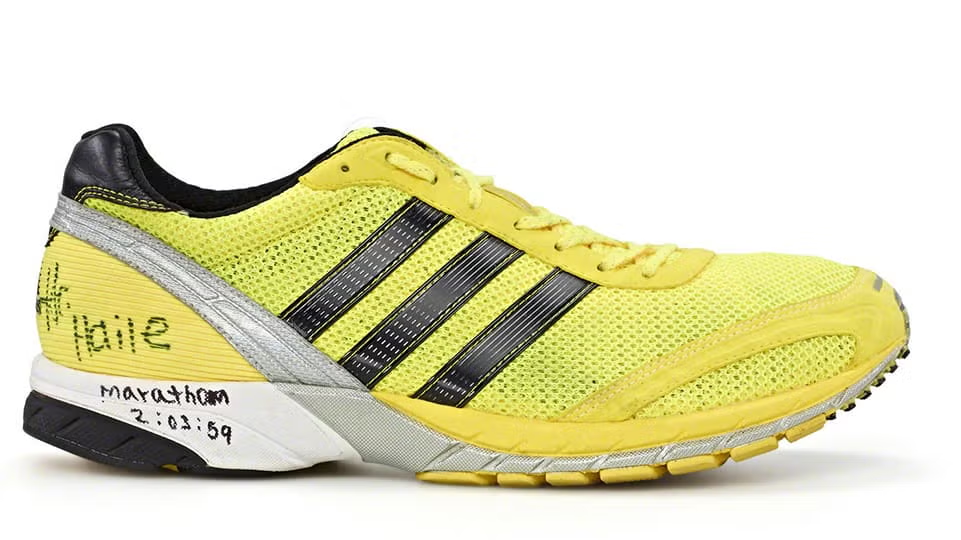
In 2004, especially in Japan where the marathon is almost a religion, a “flying shoe” meant one thing: the lightest possible protection that wouldn’t disintegrate mid-race — neither the shoe nor your legs. The first Adizero Adios carried EVA Adiprene foam, the best technology Adidas had at the time. It was light, it was fast, and in 2008, Haile Gebrselassie wore it to rewrite history in Berlin, becoming the first human to break 2:04 in the marathon with a stunning 2:03:59.
Those were different times, obviously. Then came more world records, the first superfoam revolution with Boost, and then Nike’s carbon-plate awakening that put Adidas and everyone else against the ropes. In a moment of desperation, Adidas launched the Adizero Pro — the first Adizero with a carbon plate made by Carbitex — and the line split forever.
Today, the Adios family has evolved into two distinct paths: the Adios Pro (now on version 4) with its carbon-fueled aggression, and the Adios “classic” without a plate, now on version 9, carrying forward the pure racing-flat DNA.
Technical Specifications
| Specification | Details |
|---|---|
| Weight (Men’s Size 9) | 6.2 oz / 176g |
| Stack Height | 28mm heel / 21mm forefoot |
| Drop | 7mm |
| Midsole | Full-length Lightstrike Pro foam |
| Outsole | Lighttraxion translucent TPU + Continental rubber |
| Upper | Engineered mesh (Celermesh-inspired) |
| Plate | None — traditional racing flat |
| Price | $140 / €140 |
| Release | January 2025 |
Why the Adios 9 Matters: A Complete Transformation
We’ve tested the Adios 6 and 7 — very similar shoes that kept the evolved Torsion Control system but were the first to incorporate the incredible Lightstrike Pro foam. They were spectacular shoes with a sole thickness that was minimal for what the market demanded, though much thicker than the original Adios. They lasted forever but were penalized by the use of traditional EVA in the standard Lightstrike layer.
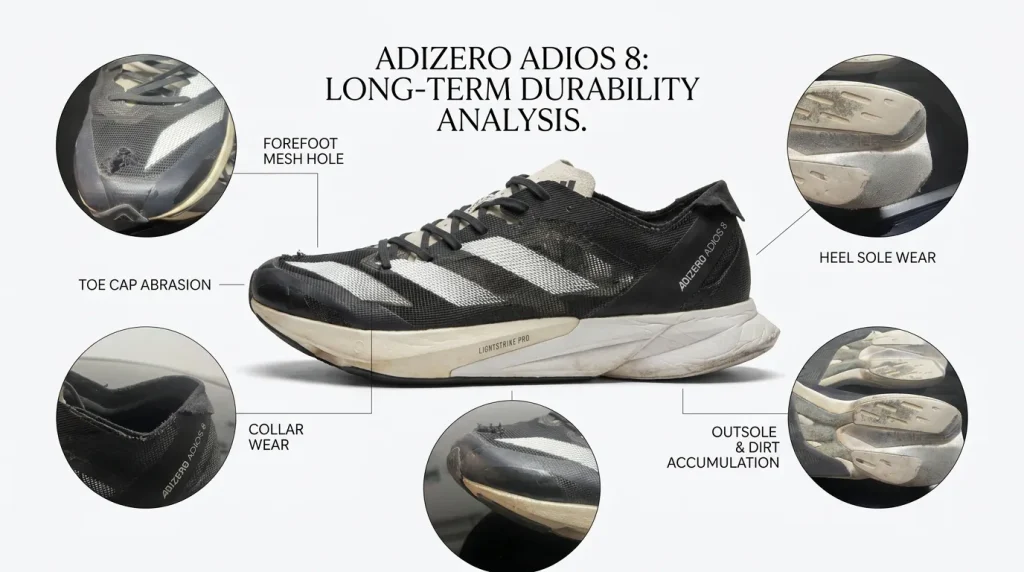
Version 8 represented a huge leap forward, still incorporating EVA in the reformulated Lightstrike 2.0, with improvements to the upper and running dynamics. But version 9? Version 9 was an absolute change.
The Foam Revolution
Adidas has finally done what purists have been waiting for: the Adios 9 uses Lightstrike Pro foam throughout the entire midsole, with no EVA blends. This is the softest, most responsive version of Lightstrike Pro that Adidas makes — the exact same compound used in the Adios Pro 4. At 28mm in the heel (though in reality, it feels like less), this is as close to the ground as you’ll get in 2025.
The Pro Upper, Finally
The Adios 9 inherits the upper from the Adios Pro 4 and Takumi Sen 11, which is significantly better than previous versions. The fit is race-tight, performance-oriented, with a noticeable taper toward the toe. There’s one caveat, though: the breathability is dreadful. It’s the trade-off for that locked-down, lightweight feel.
The Translucent Revolution
Even the translucent polyurethane outsole — something almost all Chinese brands have used for years, which Adidas calls Lighttraxion — is the same as the Adios Pro 4. It grips well, wears slowly, and keeps weight to an absolute minimum.
What’s Gone
Adidas has eliminated the Torsion Control system entirely, relying instead on the inherent properties of Lightstrike Pro and the shoe’s low profile. It’s more natural, more flexible, but less structured. Your feet will do the work now.
The Strange Marketing of a Great Shoe
Here’s the weird part: Adidas has marketed the Adios 9 strangely. In some countries, it’s barely available. Completely eclipsed by the Evo SL, it’s sold poorly and has even been hard to find. This is a shame, because the Adios 9 deserves better.
Contrary to what people might think, the Evo SL is not the complementary shoe for rotating with the Adios Pro 4. Their foams behave and feel very different. If you want to adapt your feet and muscles to the Adios Pro 4, the ideal shoe is this Adios 9. Same foam, same feel, same ground connection — just without the carbon rods and the $250 price tag.
Adios 9 vs. Adios Pro 4 vs. Evo SL: Finding Your Path
| Feature | Adios 9 | Adios Pro 4 | Evo SL |
|---|---|---|---|
| Price | $140 | $250 | $200 |
| Weight | 176g | 200g | ~190g |
| Stack Height | 28mm / 21mm | 39mm / 33mm | ~35mm |
| Midsole | Lightstrike Pro | Lightstrike Pro + Energy Rods 2.0 | Lightstrike Pro (softer) |
| Carbon/Rods | No | Yes (full-length) | No |
| Best Use | Tempo, track, 5K-10K | Race day (half/full) | Easy runs, recovery |
| Stability | Low | Moderate | Higher |
On the Run: How It Actually Feels
This is a shoe where your feet and muscles do the primary work. It’s ideal for intervals and tempos, brilliant on the track, and can comfortably carry you to a half marathon if you’re experienced and not excessively heavy. It’s neutral, quite unstable — but then again, the Adios Pro 4 isn’t a shoe you can just throw on from day one either. That’s precisely why the Adios 9 is the “ideal complement in rotation.”
Speed work and intervals: This is where the Adios 9 sings. The 20mm forefoot stack delivers exceptional ground feel and rapid turnover, mimicking the classic racing-flat experience. The Lightstrike Pro foam is responsive enough for sub-5:00/mile paces but forgiving enough for longer tempo sessions. Track workouts feel particularly sharp — the low profile and minimal weight make pace changes effortless.
Racing (5K to Half): You don’t need a carbon plate to run fast. The Adios 9 is fully capable of 5K and 10K race duties, and experienced runners can push it to the half-marathon distance. For full marathons or runners over 180 lbs, the minimal cushioning may lead to fatigue.
Stability: Let’s be honest — the Adios 9 is not stable. The narrow platform, low stack height, and absence of torsional support create a nimble but unstable ride. This is intentional. It forces your feet and lower-leg muscles to work harder, building strength over time. Not recommended for runners with ankle instability, overpronation issues, or those new to speedwork.
Fit and comfort: The upper fits true-to-size but narrow, with a tapered toe box that narrows toward the tip. Some runners recommend sizing up by half a size from previous Adios versions. The snug fit enhances lockdown but may feel restrictive for wide-footed runners.
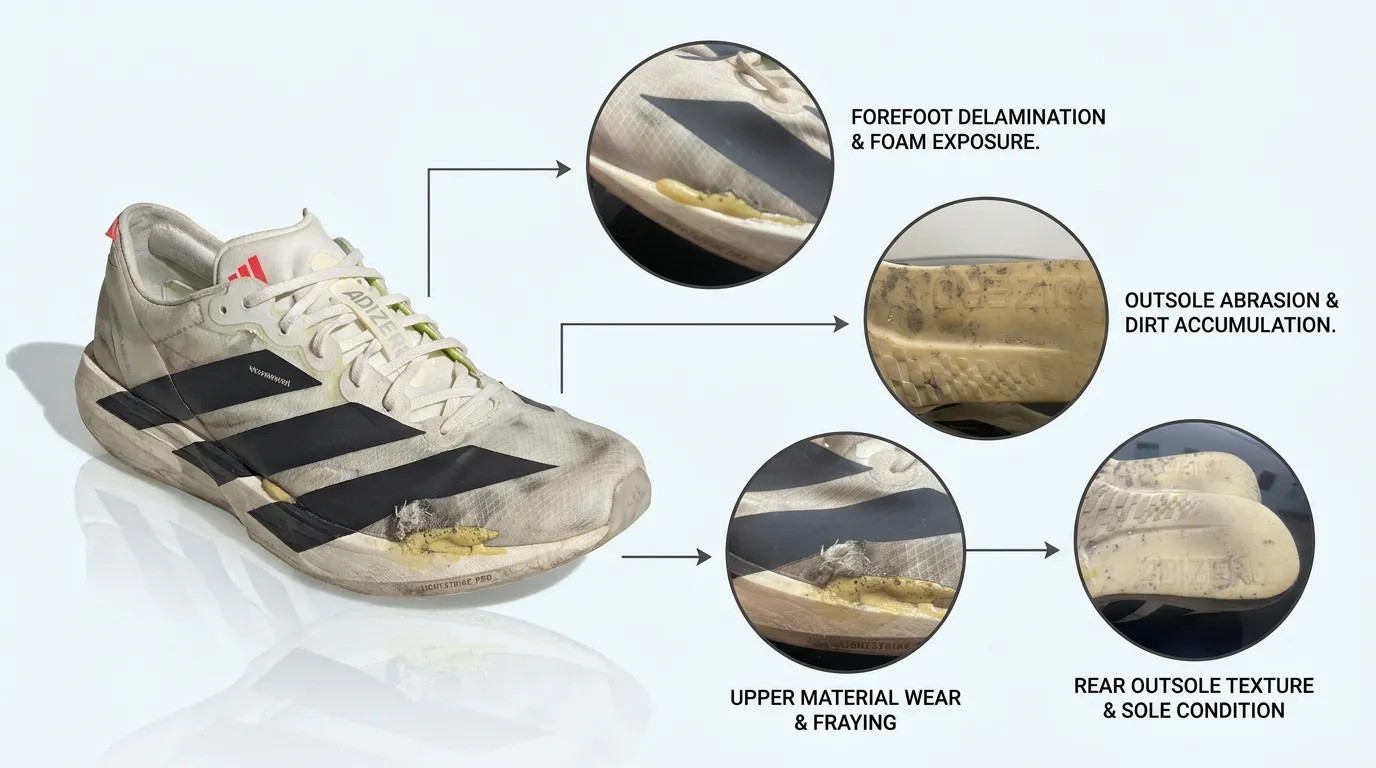
Durability: The Surprise Champion
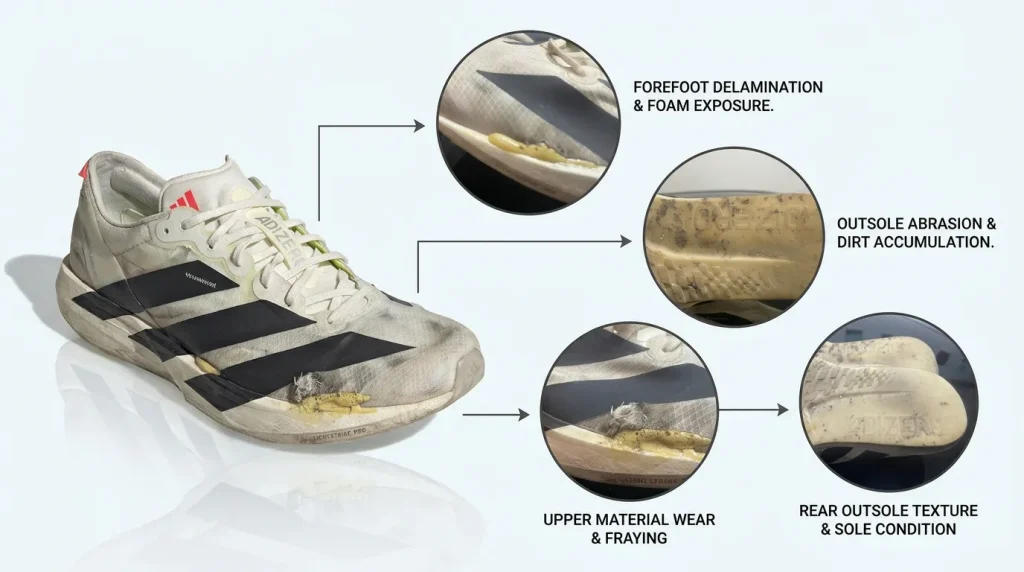
Here’s another pleasant surprise: the foam easily handles 1,000 kilometers, and it’s one of the few Adios models where the outsole remains almost intact after that distance. The upper doesn’t last quite as long — in our experience, more due to its conception and how snugly it fits (sized smaller than previous Adios versions) in the forefoot area.
The Good and The Not-So-Good
What We Love
-
- Premium Lightstrike Pro foam at an accessible $140 price
- Exceptionally lightweight at 176 grams
- Perfect for tempo runs and interval training
- Race-ready for 5K-10K without needing a carbon plate
- Durable outsole that lasts 1,000+ kilometers
- Excellent traction from Lighttraxion and Continental rubber
- Outstanding value — Pro 4 foam for nearly half the price
- Ideal training partner for the Adios Pro 4
- Brilliant for track workouts
What Holds It Back
-
- Minimal stability — not for beginners or overpronators
- tapered toe box that can feel restrictive
- Not ideal for heel strikers
- Poor breathability in the upper
- Upper durability doesn’t match the outsole’s longevity
- Limited availability in some markets
Who Should Buy the Adidas Adios 9?
Buy the Adios 9 if you:
-
- Need a dedicated speedwork shoe for intervals and tempo runs
- Want to train in the same foam as your Adios Pro 4 race shoes
- Compete in 5K-10K races and prefer minimalist racing flats
- Train on the track and value ground feel over cushioning
- Are an experienced runner with strong feet and ankles
- Want premium performance without the $250 price tag
Skip the Adios 9 if you:
-
- Need maximum stability or motion control
- Are a beginner building up speedwork volume
- Primarily run easy/recovery paces (get the Evo SL instead)
- Have wide feet or prefer spacious toe boxes
- Are a heavy heel striker
- Run marathons and need maximum cushioning
The Final Word
The Adidas Adizero Adios 9 is a return to form — a shoe that remembers its Japanese artisan roots while embracing modern superfoam technology. At $140, it’s the most affordable gateway to Lightstrike Pro, and it excels as both a speedwork specialist and the perfect training partner for the Adios Pro 4.
This isn’t a shoe that coddles you. It demands strong feet, good form, and respect for its minimalist design. But reward it with proper use, and it will reward you with blistering speed, exceptional durability, and a connection to the ground that carbon-plated super shoes simply can’t replicate.
Rating: 8.5 out of 10 — A focused, purpose-built speed shoe that delivers exceptional value for experienced runners who still believe in the art of racing flats.
Common Questions / FAQ
How does the Adios 9 compare to the Adios 8?
The Adios 9 eliminates the EVA-based Lightstrike 2.0 foam entirely, using only premium Lightstrike Pro throughout the midsole. It’s lighter (176g vs. approximately 190g), more responsive, and features an upgraded upper borrowed from the Adios Pro 4. The outsole now uses Lighttraxion translucent TPU for better durability.
Can I use the Adios 9 for marathon training?
Yes, but selectively. The Adios 9 is excellent for marathon tempo runs and goal-pace workouts, but not ideal for long runs or easy miles. Pair it with a more cushioned daily trainer like the Ultraboost Light or SL2 for high-mileage days.
Is the Adios 9 worth it if I don’t own the Adios Pro 4?
Absolutely. While it shines as a training partner for the Adios Pro 4, the Adios 9 stands on its own as a versatile speedwork shoe and capable racer for distances up to the half marathon. At $140, it’s one of the best values in the performance running category.
How long do the Adios 9 last?
The outsole remains nearly intact after 1,000 kilometers (620 miles), which is exceptional for a racing flat. The upper may show wear sooner, particularly in the toe box area due to the snug fit. Expect 400-600 miles of high-performance use before noticeable degradation.
Should I size up in the Adios 9?
The Adios 9 fits true-to-size but narrow, with a tapered toe box. If you have wide feet or prefer extra room, consider sizing up by half a size. Runners with normal-width feet should stick with their usual Adidas sizing.
What’s the difference between Lightstrike and Lightstrike Pro?
Lightstrike is Adidas’s standard EVA-based foam — firmer, heavier, and less responsive. Lightstrike Pro is a premium TPE-based superfoam similar to Nike’s ZoomX that’s softer, lighter, and provides superior energy return. The Adios 9 uses only Lightstrike Pro, while previous versions blended both foams.
Sources and Further Reading
This review synthesizes information from professional testing, technical specifications, and runner feedback. Key sources include:
- Running Warehouse – Detailed specifications, weight data, and lab-tested midsole metrics.
- Running Shoes Guru – Technical analysis, stack height measurements, and ride dynamics.
- Meta Endurance – Release information, pricing, and on-foot performance reviews.
- Road Trail Run – In-depth comparative analysis with the Adios Pro 4 and Evo SL.
- RunRepeat – Foam technology breakdown, durability testing, and aggregated user feedback.
- RTINGS.com – Objective laboratory testing, performance metrics, and fit analysis.
- Adidas Official – Official product details, designer Toshiaki Omori’s philosophy, and historical context.