
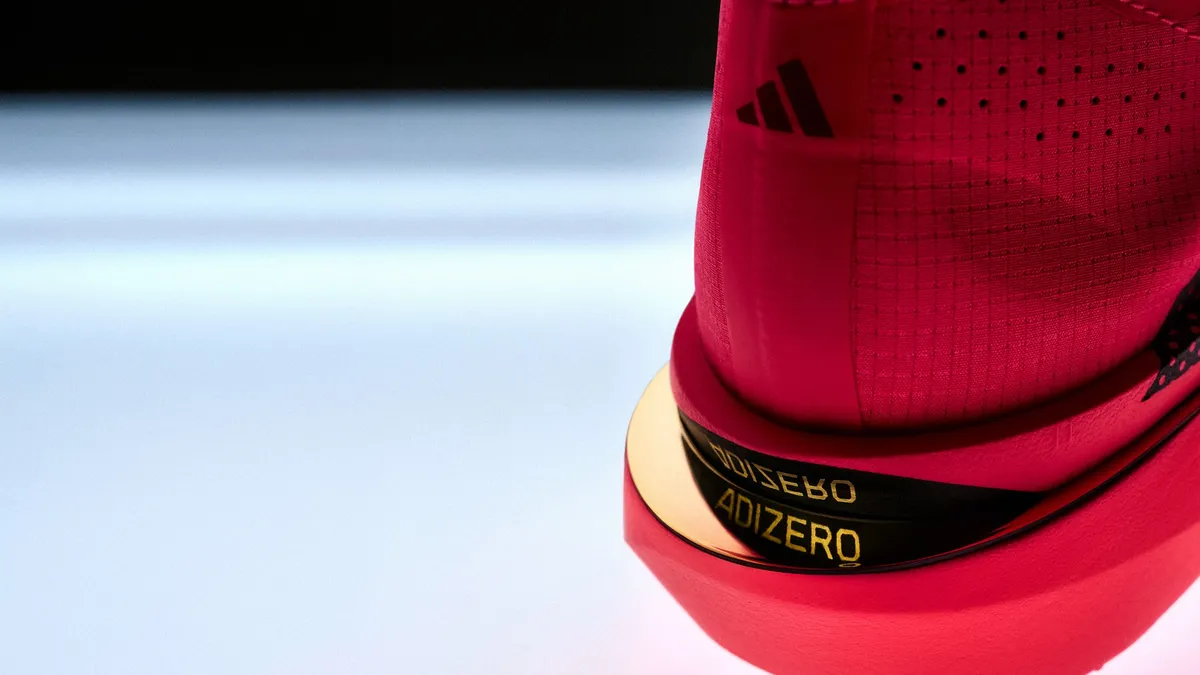
On 22 September 2026 Adidas unveiled the Adizero Adios Pro 5 – a race day super shoe harnessing Evo 3 DNA.
The marathon racing world has a new heavyweight contender. Adidas has officially unveiled the Adizero Adios Pro 5, a cutting-edge “super shoe” engineered with structural DNA inherited directly from the record-breaking Adios Pro Evo 3 platform. If you are looking for an ultra-lightweight, high-performance racing weapon to shatter your personal bests, this release marks a massive evolutionary leap for the Adizero franchise.
Rather than delivering a minor cosmetic update, Adidas has fundamentally overhauled its racing architecture: retiring the internal carbon EnergyRods, pivoting away from pure TPEE foam chemistry, dropping the heel-to-toe offset, and shaving weight down to an unbelievable 177 grams.
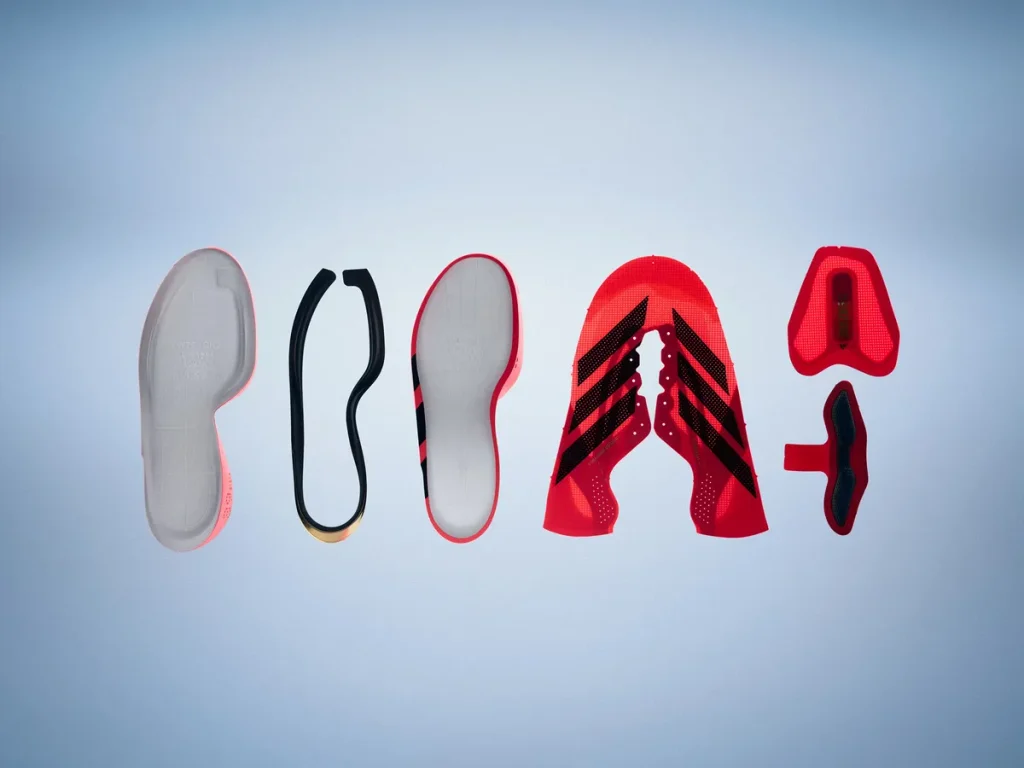
Adizero Adios Pro 5: Quick Spec Sheet
177g (UK 8.5 / US 9)
-23g (~12% lighter than Pro 4)39mm Heel / 35mm Forefoot
Aggressive 4mm DropCarbon EnergyRim
Replaces EnergyRods 2.0Dual PEBA + ATPU
Plush top / Structural carrierPart I: Key Performance Specs & Engineered Upgrades
- Massive Weight Reduction (177g): Clocking in at a stunning 177 grams in UK size 8.5 (US 9), the Adios Pro 5 is roughly 23 grams lighter than the Adios Pro 4. In a 42.195 km race where an athlete takes approximately 25,000 to 30,000 strides, this 12% weight drop drastically improves rotational pendulum swing and leg economy in the final 10 kilometers.
- The EnergyRim Overhaul: Adidas has officially retired its signature internal carbon-fiber EnergyRods 2.0. In their place sits the EnergyRim—a carbon-infused perimeter frame that cradles the outer edges of the shoe. By moving the structural rigidity to the periphery, an uninterrupted, monolithic block of foam sits directly beneath the footbed, driving a measured 9% increase in energy return.
- Aggressive 4mm Geometry: Dropping from the traditional 6mm offset to a lower 4mm drop (39mm heel / 35mm forefoot), the Pro 5 packs significant foam volume directly under the metatarsals. This flatter, thicker forefoot platform is specifically sculpted to cushion high-velocity forefoot strikes.
- Lightlock 2.0 Upper & Lighttraxion Outsole: The newly developed woven mesh upper integrates internal tensor support bands to prevent fabric stretch under lateral loads. Underneath, a minimal Lighttraxion rubber pattern is bonded with genuine Continental™ Rubber on high-wear forefoot strike zones for uncompromising wet-weather cornering grip.
| Feature | Adizero Adios Pro 4 | Adizero Adios Pro 5 |
|---|---|---|
| Weight (UK 8.5) | ~200 grams | 177 grams (-23g / -12%) |
| Propulsion System | Carbon EnergyRods 2.0 (Internal) | Carbon-infused EnergyRim (Perimeter) |
| Stack & Drop | 39mm / 33mm (6mm drop) | 39mm / 35mm (4mm drop) |
| Foam Chemistry | Supercritical TPEE (Lightstrike Pro) | Dual-Density PEBA Top + ATPU Bottom Chassis |
Part II: Mechanical Analysis via SEGASU Running – The Great Foam Pivot
When it comes to deep-dive mechanical teardowns, prominent footwear analyst SEGASU Running provides crucial insights into how the Adios Pro 5 actually behaves under load, especially when stacked against its primary adversary: the Nike Alphafly 4.
🔬 SEGASU Breakdown: The Departure from Pure TPE
For multiple generations (Pro 1 through Pro 4), Adidas relied heavily on supercritical TPEE (Thermoplastic Polyester Elastomer) supplied by Shincell. However, as SEGASU highlights, Adidas pushed pure TPEE to its structural limit in the Pro 4. To push energy rebound past the 88% threshold while simultaneously shedding weight, Adidas completely re-engineered its underfoot formulation into a dual-density compound layout:
- Soft PEBA Top Layer: Positioned directly beneath the strobel board for plush compliance, dynamic sinking depth, and explosive vertical energy return.
- Firm ATPU Carrier Bottom Layer: Positioned closer to the ground to act as a structural chassis, stabilizing the shoe and preventing premature breakdown of the softer PEBA layer.
As SEGASU notes, this composite PEBA + ATPU architecture closely mirrors the engineering methodology Asics introduced in its original Metaspeed Sky and Edge series. By sandwiching the carbon EnergyRim between a hyper-reactive top layer and a firm guiding base, Adidas achieves plush compliance without structural collapse.
Part III: Head-to-Head: Adizero Adios Pro 5 vs. Nike Alphafly 4
SEGASU Running’s technical comparisons uncover stark mechanical differences in how the Adios Pro 5 and the Nike Alphafly 4 handle foot-strike dynamics and ground transitions:
1. Midfoot Stability vs. Cutout
Nike aggressively carves out the midfoot of the Alphafly 4 to shed weight, producing a highly segmented chassis focused almost exclusively on a forefoot strike. Adidas does the opposite: they filled in the lateral midfoot cutout from the Pro 4. This continuous slab of midfoot foam creates a significantly more stable landing zone for fatigued midfoot and heel strikers.
2. Aggressive Rocker vs. Toe Snap
Due to its low 4mm offset, the Pro 5 utilizes an extremely pronounced toe spring and early-stage rocker to roll the runner forward. SEGASU notes runners with limited big-toe flex might find this curve intense. Conversely, the Alphafly 4 uses a flatter toe spring, extending its carbon Flyplate directly to the tips of the toes for a sharp mechanical snap.
⚠️ The Break-In Period Warning
Because of the dual PEBA and ATPU carrier assembly, SEGASU highlights that the Adios Pro 5 will require a distinct 20–30 km break-in period to soften the interface between the two polymers. Unlike the instant, trampoline-like bounce of Nike’s radio-wave molded ZoomX LT foam straight out of the box, the Pro 5 unlocks its most fluid, compliant ride after its initial heat and compression cycles.
Part IV: Biomechanical Verdict
Ultimately, the Adidas Adizero Adios Pro 5 emerges as the noticeably lighter marathon racer (~177g vs. Nike’s estimated ~198g in equivalent US Men’s 9). By filling in the midfoot gap and stabilizing its PEBA top layer with an ATPU structural carrier and the EnergyRim, Adidas has engineered a rolling, highly cushioned platform that accommodates a wider spectrum of runner mechanics than the hyper-segmented, forefoot-dominant Alphafly 4.
🔗 References, Sources & Further Reading
- Official Launch Details: Read the official announcement, global availability dates, and colorway lineup via the Official Adidas Adizero Adios Pro 5 Press Release.
- Expert Video Teardown: Watch the full video review, flexibility tests, and ride comparisons on the SEGASU Running YouTube Channel.
- Community Discussions & Weight Comparisons: Track verified user unboxings, scale weights, and foam density breakdowns on Reddit’s r/RunningShoeGeeks.
- Elite Racing Insights: Follow real-time elite road tests and World Marathon Major results on the LetsRun Footwear Forum.