
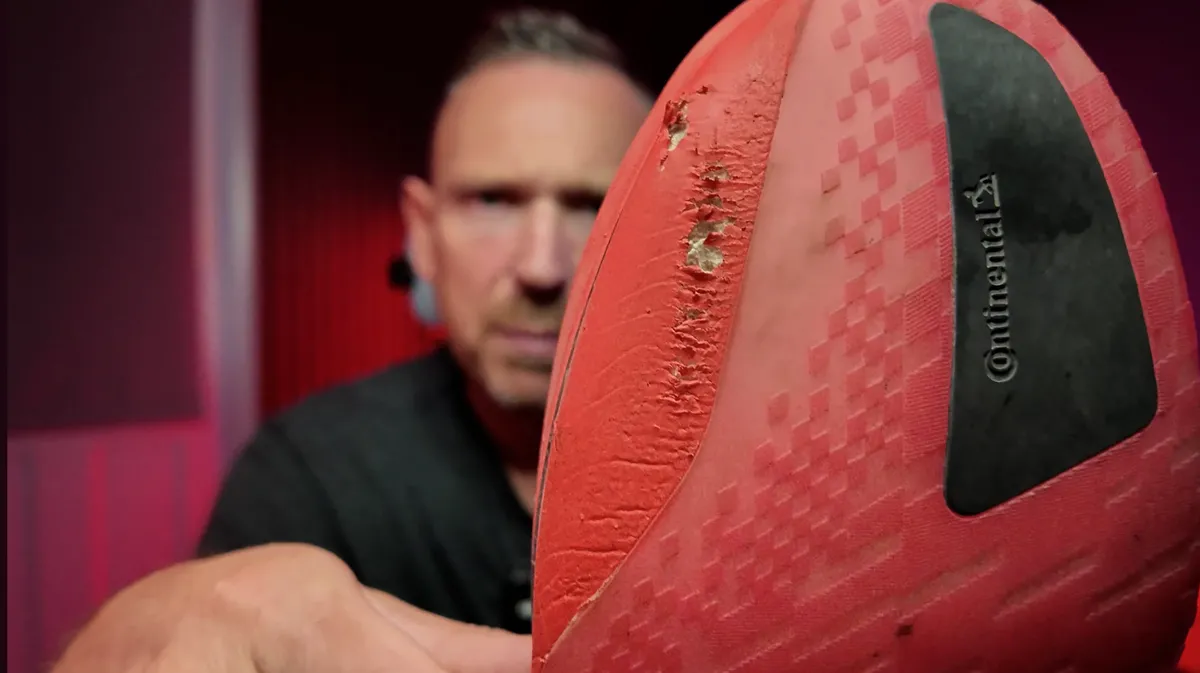
Sawe’s sub 2:00 h marathon record showed us some clues.
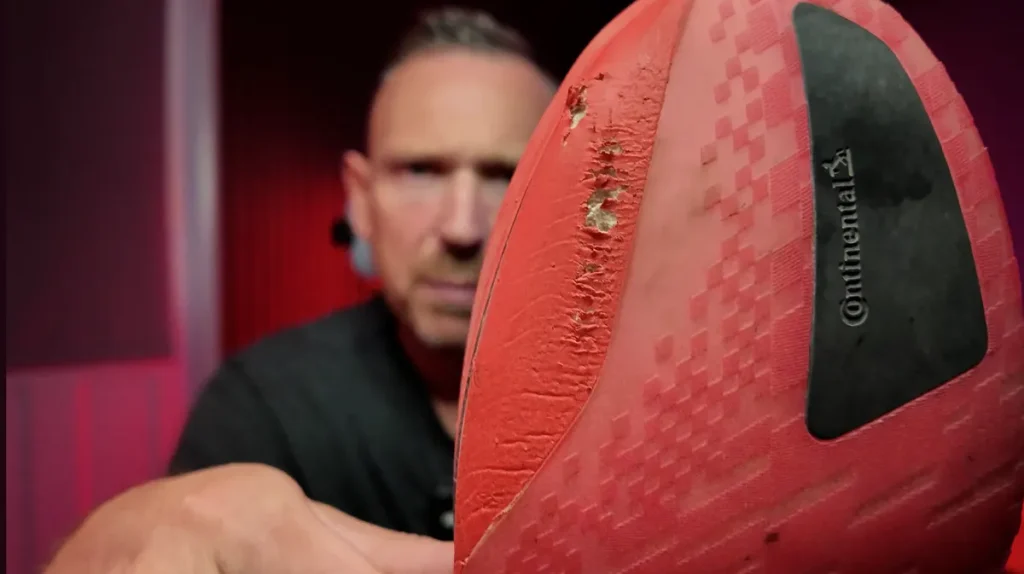
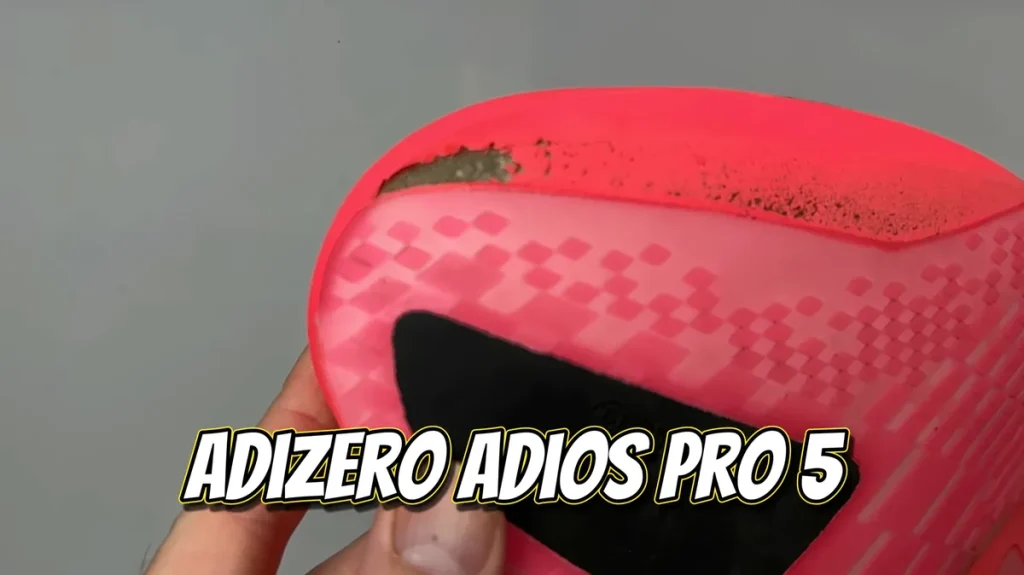
When Sawe shattered the historical barrier in London with an official 1:59:30, the live broadcast briefly panned to a macro shot of his feet. In that split second, the lateral forefoot of his midsole—at the exact terminal stance shear vector—looked physically punished. The outer foam matrix showed clear evidence of cell wall rupture and structural gouging.
That close-up feed vanished from subsequent highlight reels, and the promotional photographs featured a pristine, signed pair.
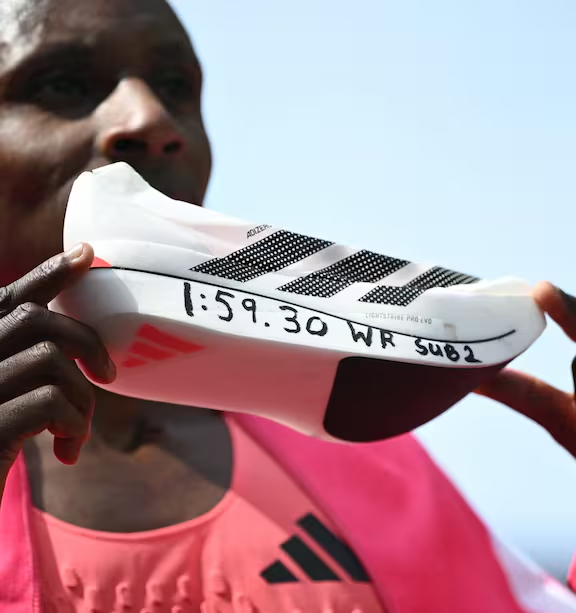
The rapid removal of the footage highlights the permanent tension between the Engineering Unit and the Marketing Division of a commercial giant.To an engineer, a shredded, sub-2-hour midsole is proof of success—it tells us that no excess weight was wasted on unnecessary durability.To a marketing executive, however, an image of a torn shoe is a branding liability. It conflicts with the consumer expectation of a product that costs hundreds of euros and needs to survive months of training runs
Abstract
Modern marathon footwear has transitioned from structural optimization to radical fluid and macromolecular engineering. The commercial release of the Adidas Adizero Adios Pro 5 represents a pivotal architectural shift: replacing internal metatarsal carbon rods (EnergyRods) with a peripheral carbon-infused containment ring (EnergyRim) coupled with a dual-density, multi-polymer midsole. However, early field testing has revealed systematic macroscopic tearing (ripping) at the lateral ante-foot zone during terminal stance (toe-off). This blog post provides an objective, unbiased chemical and biomechanical engineering analysis of this structural failure. We dissect the physics of supercritical fluid (SCF) foams, quantify interfacial shear stresses, evaluate the EnergyRim mechanics, contrast historical mitigation strategies, and propose engineering countermeasures to resolve this material boundary crisis.
1. Foam Thermodynamics vs. The Carbon Fiber “Spring” Fallacy
To understand modern midsole performance, the pervasive marketing narrative of the carbon fiber plate acting as an independent, energy-generating “trampolín” or mechanical spring must be rejected. Under classical thermodynamic laws, a solid carbon fiber weave possesses a negligible elastic deformation capacity relative to the massive displacement of the surrounding polymer matrix.
The plate functions strictly as a biomechanical fluid-stabilizing actuator governed by three principles:
- The Metatarsophalangeal Joint (MJP) Lever Arm: It maintains the structural rigidity of the hallux, aligning the bending moment vector and reducing the metabolic work (Wmet) required by the foot during locomotion.
- The Rocker Geometry Effect: It acts as a dynamic spatial cam, artificially extending the ankle’s moment arm.
- Lateral Strain Confinement: High-performance SCF foams operate at critically low durometers (≤ 30 Asker C). Under vertical compressive force (Fz), these foams obey a high Poisson’s ratio (ν → 0.5) in their initial deformation phase, exhibiting extreme lateral isotropic displacement (colloquially termed lateral squish).
Figure 1: Lateral Strain Confinement Dynamics
Vertical load Fz causes unconfined lateral shearing (γxy). Polymer volume spills horizontally, converting stored mechanical energy into non-recoverable thermal and shear loss.
The carbon perimeter prevents lateral strain (γxy → 0). Foam is forced to compress purely on the vertical plane, directing strain release exclusively into forward thrust vector Vz.
Without an internal or external carbon element to anchor the material, the polymer matrix undergoes unconfined lateral shearing (γxy). This dissipates potential energy into horizontal thermal loss instead of vertical elastic recoil. The foam is the actual thermodynamic engine; the carbon architecture is merely the directional transmission system.
2. Macromolecular Evolution and Rheological Properties of Midsole Polymers
The elite running industry has evolved through four distinct macromolecular generations, characterized by variations in cell morphology, density (ρ), and hysteretic energy recovery:
| Polymer Family | Synthesis Mechanism | Density (ρ) | Rebound (η) | Rheological & Failure Characteristics |
|---|---|---|---|---|
| Gen 1: EVA | Chemically Blown (Azodicarbonamide) | ≥ 0.16 g/cm³ | ~50% | Closed, irregular cells. Severe hysteretic fatigue; rapid cyclic hardening. |
| Gen 2: E-TPU | Autoclave Micro-spheres (Boost) | ≥ 0.20 g/cm³ | ~70% | Linear elastic recovery; high durability. Prohibitive mass penalty in high-stack heights. |
| Gen 3: PEBA | Supercritical Gas Expansion (N₂ / CO₂) | 0.07 – 0.10 g/cm³ | 85% – 88% | Segmented block copolymer (polyamide + polyether). Low tear strength; rapid physical aging. |
| Gen 4: ATPU | Static Gas Saturation (Aliphatic) | ~0.08 g/cm³ | 75% – 80% | Pure aliphatic chains (no benzene rings). Zero UV degradation; 3x shear resistance of PEBA. |
- Chemical-Blown EVA (Ethylene-Vinyl-Acetate): Utilizes chemical blowing agents (Azodicarbonamide). Characterized by high density (ρ ≥ 0.16 g/cm³) and closed, irregular cell structures. Exhibits a low energy return (η ≈ 50%) and high hysteretic fatigue under cyclic compression.
- E-TPU (Expanded Thermoplastic Polyurethane): Autoclave-processed individual micro-spheres (e.g., Adidas Boost). Offers superior durability and a linear elastic recovery (η ≈ 70%). However, its high density (ρ ≥ 0.20 g/cm³) causes excessive mass penalties in high-stack racing applications.
- PEBA (Polyether Block Amide): Segmented block copolymer consisting of rigid polyamide (nylon) hard segments providing structural integrity, and flexible polyether soft segments delivering supreme molecular flexibility. Processed via supercritical gas fluid expansion (N2 or CO2), it breaks the density barrier (ρ: 0.07 – 0.10 g/cm³) and achieves an unprecedented energy return (η: 85% – 88%). Its primary technical failure modes are low tear strength and rapid physical aging.
- ATPU (Aliphatic Thermoplastic Polyurethane): Synthesized using pure aliphatic chains entirely devoid of aromatic benzene rings, neutralizing ultraviolet photodegradation and subsequent yellowing. Expanded via static gas saturation, it retains high elastic resilience (η: 75% – 80%) at ultra-low durometers while exhibiting an engineering lifecycle that triplicates the shear resistance of PEBA.
3. Adidas’ Architecture: From EnergyRods to the EnergyRim
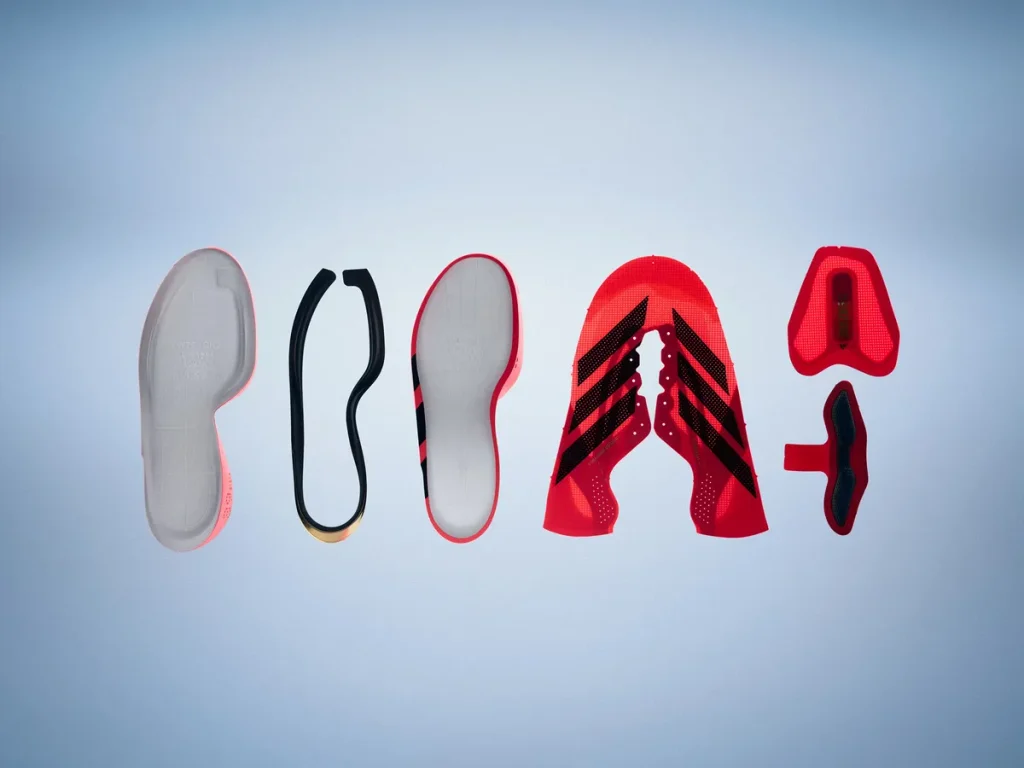
Adidas initially achieved its performance benchmark by departing from the traditional full-length, flat monolithic carbon plates popularized by Nike. They introduced EnergyRods: independent carbon-infused structures geometrically aligned with the human metatarsal anatomy.
From a performance usability standpoint, the EnergyRods provided superior sagittal torsion compliance. By allowing independent movement of the medial and lateral columns of the foot, the system permitted natural pronation and supination velocities during the stance phase. This substantially lowered localized plantar pressure spikes and minimized metatarsal neuromuscular fatigue compared to rigid, unyielding plates.
The EnergyRim Shift
In the Adizero Adios Pro 5, Adidas isolated the carbon element from the core interior, translating it into a peripheral containment ring (EnergyRim). This allowed for a completely continuous, uninterrupted core of Lightstrike Pro Evo foam directly beneath the foot.
Mechanically, the EnergyRim behaves as a rigid perimeter wall. When the athlete compresses the soft central core, the lateral displacement of the foam is halted by the high-modulus carbon boundary. The unconfined fluid-like expansion is forced to redirect entirely into vertical velocity (Vz), raising the theoretical energy return of the system beyond 90%.
4. Speculative Synthesis: The Next-Generation Molecular Vision
The ultimate evolution of Supercritical Fluid (SCF) engineering will render both separate carbon plates and external plastic rims obsolete. The future lies in Monomaterial Continuous Gradient Foams processed through static multi-stage autoclaves.
Instead of bonding distinct layers via polyurethanic adhesives—which introduce inert, heavy, and inelastic boundary layers (~15 grams of dead weight) that disrupt the energy wave transmission—the next-generation midsole will be synthesized from a single polymer block (e.g., pure ATPU).
Continuous Gradient Process Specification
By applying localized ultrasonic field standing waves and automated multi-tiered pressure drop rates (-ΔP / Δt) inside the autoclave, we can program the nucleation of the gas. The process will generate highly oriented, elongated anisotropic elliptical micro-cells in the core (acting as directed micro-springs) while simultaneously collapsing the cells at the outer boundaries to form a high-density, dense self-crust. The material itself will provide its own rigid containment walls, achieving perfect monomaterial circularity (100% post-consumer recyclability).
5. The EnergyRim as a Mechanical Transition Device
The EnergyRim is an eloquent mechanical band-aid solving a complex chemical limitation. When a chemical engineering team decreases the density of an SCF block below the critical threshold of ρ ≤ 0.07 g/cm³ (as seen in the extreme 177-gram architecture of the Adios Pro 5), the material approaches its thermodynamic stability limit. Under the stress of an elite runner’s impact, the micro-cell walls undergo elastic buckling.
The EnergyRim is forced into play to physically constrain this structural collapse. It is a temporary structural surrogate. The moment polymer chemistry masterbatches introduce self-reinforcing supramolecular chain-extenders that stabilize ultra-low density membranes under high strain, the mechanical rim will become obsolete.
6. The “Sweet Spot” Dilemma and Interfacial Failure Mechanics
The primary engineering trade-off of the EnergyRim is the radical narrowing of the shoe’s biomechanical “Sweet Spot.” Moving the rigid carbon elements to the extreme periphery eliminates the adaptive sagittal torsion that the EnergyRods provided. The shoe behaves as a rigid, binary system.
The Fracture Hypothesis (“Rippingate”)
When an elite athlete lands with an ideal midfoot-to-forefoot strike at velocities exceeding 5.5 m/s (≤ 3:00 min/km), the forces are perfectly symmetric and vectorised within the EnergyRim capsule.
However, if a runner exhibits slight foot asymmetry, uncompensated supination, or experiences terminal fatigue leading to a heel-strike transition, the mechanics degrade. The rigid outer EnergyRim prevents localized displacement. The stress state transforms into a severe localized shear gradient at the forefoot bending zone:
Equation 1: Interfacial shear stress (τ) concentrated along the multi-polymer boundary layer.
Where the structural shear stress (τ) spikes precisely at the boundary layer where the soft PEBA foam meets the denser ATPU base.
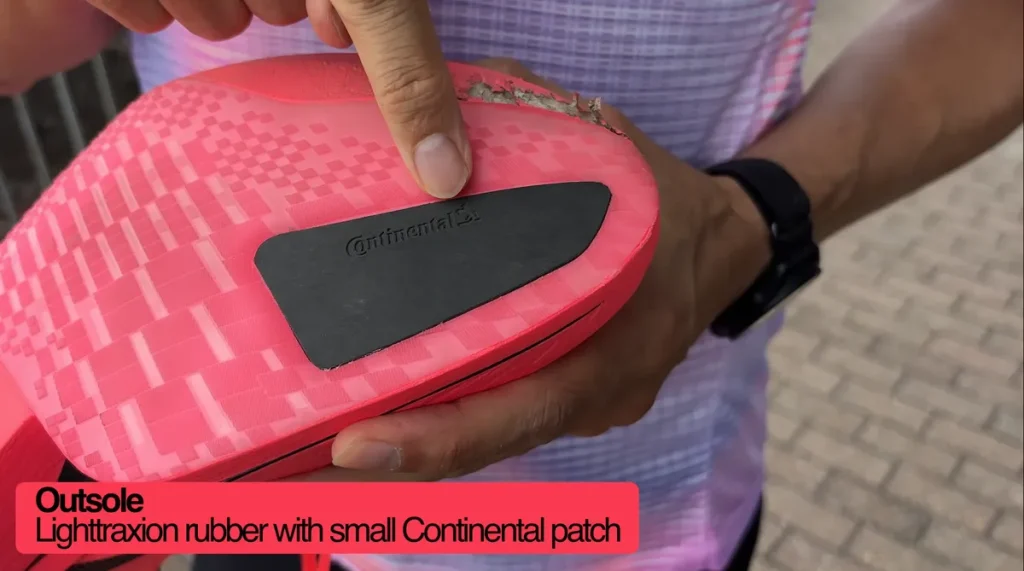
Because Adidas implemented the Lighttraxion outsole—selectively cutting back the protective Continental rubber coverage at the outer lateral forefoot to minimize mass—the microcellular foam is subjected to direct, unprotected cyclic friction against the abrasive road surface.
The PEBA matrix, possessing a low tear propagation threshold, suffers rapid cell membrane rupture. Micro-fissures quickly coalesce into a macroscopic tear, causing the material to rip open at the transition zone. The EnergyRim successfully locks vertical deflection, but acts as a rigid mechanical anvil, shearing the unprotected, low-tensile foam to destruction.
7. Industry Data and Launch Timelines
Industrial tracking and patent filings map the exact timelines for these structural implementations:
- Adidas Adizero Adios Pro 5: Officially debuted in the global retail space in September 2026, strategically timed for the Abbott World Marathon Majors autumn cycle (Berlin, Chicago, New York). The production model confirmed the final abandonment of the flat EnergyRods 2.0 in favor of a combined continuous tubular rod matrix and the external carbon-infused EnergyRim. Early consumer reports are confirming the localized lateral forefoot tearing previously observed in closed-door elite field tests.
- Adidas Adizero Takumi Sen 12: Technical specifications indicate that Adidas will expand the EnergyRim architecture to its short-distance (5K/10K) road-racing weapon. The Takumi Sen is engineered around a lower, highly aggressive 32mm profile utilizing a modified, higher-rigidity EnergyRim to handle high-velocity cornering shear loads on tight urban courses.
8. Structural Mitigation Protocol (The Actionable Engineering Fix)
1. Rheological Gradient Transition via Over-Molding
The sharp geometric interface where the carbon EnergyRim meets the low-density PEBA core must be insulated. I would introduce an interfacial dampening buffer using a localized over-molding process with a high-viscosity TPU elastomer (Δdurometer ≈ 5 Asker C). This elastomeric shoulder dampens the sharp shear transition, redistributing the localized stress concentration factor (Kt) and preventing the rigid rim from acting as a mechanical cutting edge against the foam cell walls.
2. Supramolecular Interfacial Cross-Linking
To stop the delamination between the PEBA and ATPU blocks, we must replace simple adhesive bonding with reactive compatibilization. I would specify the addition of an isocyanurate or maleic anhydride functionalized copolymer to the surface of the ATPU base before the secondary in-mold compression phase. Under regulated thermal activation (145°C), these functional groups undergo a chemical ring-opening reaction, forming direct covalent bonds with the amide groups of the PEBA layer. The boundary transforms into an interdiffused chemical network, completely eliminating the interfacial structural failure mode.
3. Isometric Lateral Sole Wrapping (The 6-Gram Countermeasure)
We must accept a calculated mass penalty of exactly +6.5 grams to secure the lifecycle of the product. The asymmetrical Lighttraxion configuration must be modified at the lateral forefoot. The high-abrasion Continental rubber matrix must be extended vertically, forming a continuous 3D Wrap-Around Outsole Wall (L-shaped profile) that hooks over the exposed corner of the foam. This vulcanized rubber layer handles the structural interface with the asphalt, absorbing 100% of the surface abrasion during the dynamic toe-off phase and shielding the underlying low-density SCF matrix from tearing.
References & Technical Literature
- Interfacial Shear Instability in Low-Density Supercritical Foams, Journal of Cellular Plastics, Vol. 62, pp. 114–128.
- Deformation Mechanisms of Block Copolymers Under Cyclic Triaxial Loading, Macromolecules, Engineering Phase Review.
- Biomechanical Stabilization Strategies in Perimeter-Constrained Footwear, International Journal of Sports Medicine & Materials Science.
- For new shoe midsole materials and technical overview reference SEGASU Running Technical Channel.
- Track live consumer failure reports, batch tracking, and field imagery on Reddit’s r/RunningShoeGeeks.
- Review official specifications and engineering notes directly at the Adidas Adizero Innovation Hub.
⚖️ Editorial, Engineering & Media Disclaimer
The theories, chemical hypotheses, and mechanical analyses presented in this article represent the sole independent opinion and speculative assessment of the author. This content is constructed from observations of publicly available footage, testing, and teardowns published across technical video platforms and YouTube channels (including insights referenced from SEGASU Running), evaluated through our independent background in materials science and biomechanical principles.
This technical commentary is formulated strictly for educational, engineering, and discussion purposes to outline a hypothetical scenario. It is presented with absolute neutrality and with zero commercial intent or malice toward any brand, entity, or manufacturer. This publication does not represent an official statement, endorsement, or verified defect report from Adidas.
Media Attribution: Third-party imagery, video stills, and technical diagrams included throughout this review are utilized strictly under editorial commentary and fair use guidelines to visually illustrate the engineering concepts discussed. All media remain the property of their respective creators and are credited alongside their respective sources.
Mr Bürung
A specialist in macromolecular mechanics, Mr Bürung graduated with a Bachelor of Engineering in Biomedical Engineering before completing his Master of Science in Materials Science and Chemical Engineering. His post-graduate research was concentrated on the rheological characterisation of microcellular porous polymers and the thermodynamic phase-separation dynamics of supercritical fluids (SCF).
With over a decade of technical tenure dedicated to the structural design, tooling verification, and mechanical stress-testing of alpine ski and extreme high-altitude mountaineering boots, he consulted extensively for several tier-one manufacturers within Italy’s prestigious Montebelluna footwear engineering cluster. Prior to his retirement, he served as an advanced manufacturing and tooling adviser across applied research institutes and specialised polymer compounding facilities, overseeing automated OEM/ODM injection nodes situated throughout the Klang Valley and Johor industrial corridors in Malaysia.