
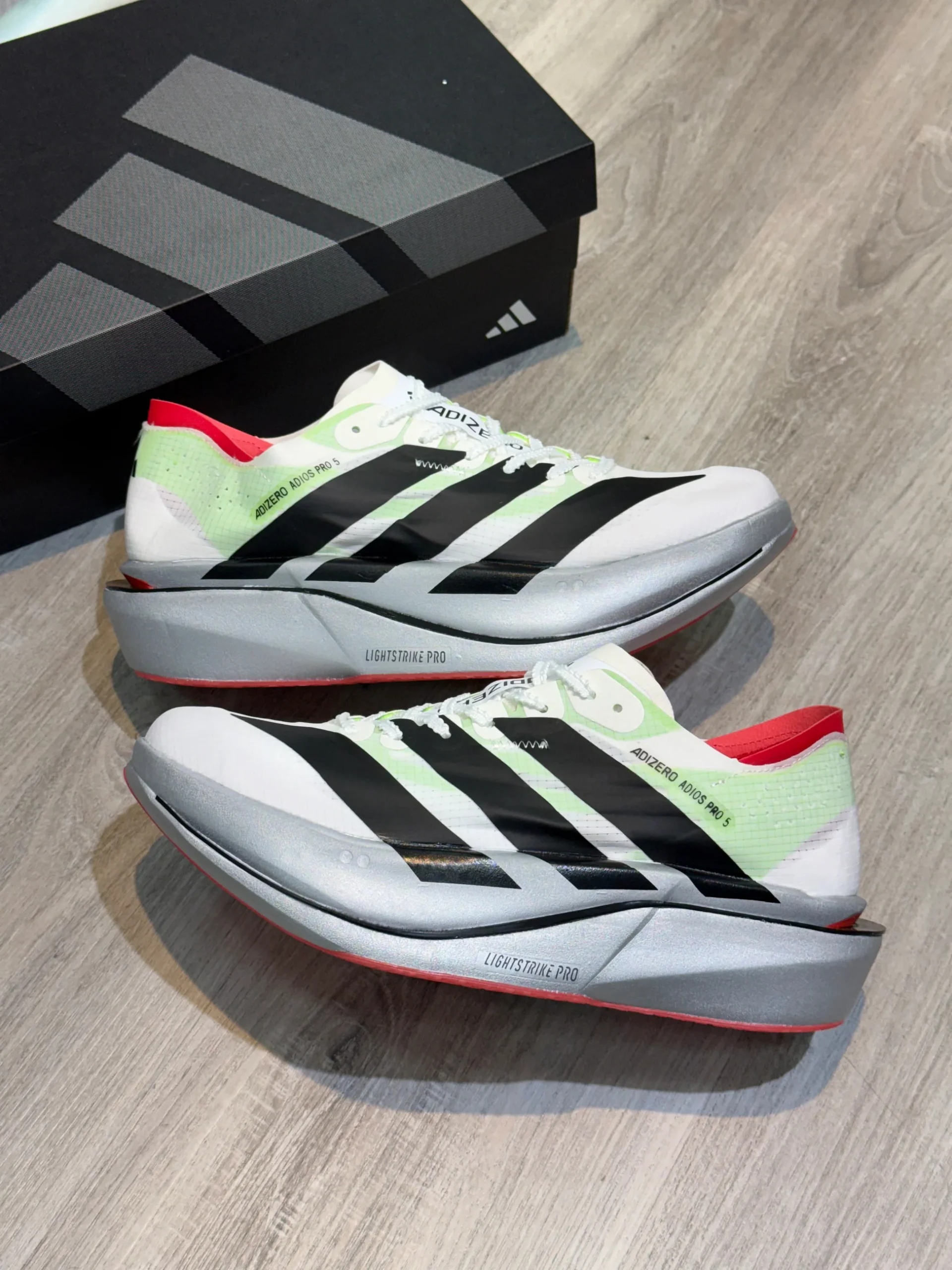
LAST UPDATE!!
The Adidas Adizero Adios Pro 5 has officially landed in the hands of major running influencers and YouTubers, coinciding with its launch window around the Berlin Marathon.
The shoe launchment has been controversial due to initial durability issues, mainly in the sole, and the new EnergyRim. Check more articles in this blog to furter now baout it.
Mid September a youtuber has published a youtube video showing the actual product.He claims a major Canadian retailer has placed them online by mistake and he was able to purchase the pair. Below you have the video to judge by yourself. Everything points to Berlin Marathon as the date chosen by adidas for the launch.
Important: A deep technical analysis into the physics of Adidas’ upcoming Adizero Adios Pro 5 and Takumi Sen 12. We have dived into forums, ask industry insiders and try to find out but final product from Adidas may differ.
Recent rumours point to Takumi Sen 12 being released on November after adios pro 5 during Berlin’s marathon.
In the hyper-competitive world of asphalt marathon racing, we are witnessing a fundamental shift in how performance footwear is engineered. For nearly a decade, consumer marketing convinced the running world that curved carbon-fiber plates acted like independent mechanical trampolines—catapulting athletes forward with every stride.
As materials scientists and footwear product managers know, this was a brilliant thermodynamic fallacy. Carbon fiber possesses negligible elastic deformation under human load when compared to the volume of the surrounding foam. The carbon plate never was the engine; it was the transmission. The true miracle of modern distance running lies in the chemical synthesis of Supercritical Fluid (SCF) foams.
The Dual Mechanic of Super-Shoes
- Stores & releases kinetic strain energy
- Provides vertical compliance
- Ultra-low density (<0.07 g/cm³)
- Restricts lateral isotropic shear force
- Directs expansion along the Z-axis
- Stabilizes fluid foam instability
Now, following the ultra-exclusive debut of the 97-gram Adizero Adizero Evo 3 platform—the catalyst that pushed the boundary of sub-two-hour marathon performance—Adidas is preparing its next major commercial assault: the Adizero Adios Pro 5 and the short-course Adizero Takumi Sen 12.

Behind closed doors in Scheinfeld and Portland, engineers are grappling with a new paradigm: the EnergyRim.
Part I: Macromolecular Evolution – Foam Over Carbon
To understand where the Adios Pro 5 and Takumi Sen 12 are heading, one must map the four distinct chemical eras of modern marathon midsoles:
| Polymer Family | Density Metric | Energy Return | Mechanical Limitations & Industry Profile |
|---|---|---|---|
| 1. Conventional EVA | ≥ 0.16 g/cm³ | ~50% | Chemically blown. High hysteresis fatigue; hardens rapidly over distance. Relegated to budget trainers. |
| 2. E-TPU (Boost) | ≥ 0.20 g/cm³ | ~70% | Autoclave particle structure. Highly durable, but prohibitive mass limits modern marathon race stacks. |
| 3. PEBA (ZoomX / PWRRUN PB) | 0.07 – 0.10 g/cm³ | 85% – 88% | Polyether Block Amide. Ultra-plush and explosive initial bounce, but suffers high compression set and short mechanical lifespan (<250 km). |
| 4. TPEE (Adidas Lightstrike Pro) | 0.08 – 0.11 g/cm³ | 82% – 85% | Supercritical Thermoplastic Polyester Elastomer (Shincell formulation). Exceptional structural longevity (500+ km), zero thermal stiffening in cold weather, and structural resilience. |
| 5. ATPU (Aliphatic TPU / FF LEAP) | ~0.08 g/cm³ | 75% – 80% | Pure aliphatic chains (no benzene rings). Zero UV yellowing, plush compliance, 3x lifespan of traditional PEBA. |
Why Adidas Bet on TPEE Over PEBA
Unlike most competitors who rushed to embrace PEBA (Pebax), Adidas made a deliberate chemical choice when developing Lightstrike Pro: they partnered with supercritical foaming specialists (such as Shincell) to utilize TPEE (Thermoplastic Polyester Elastomer).
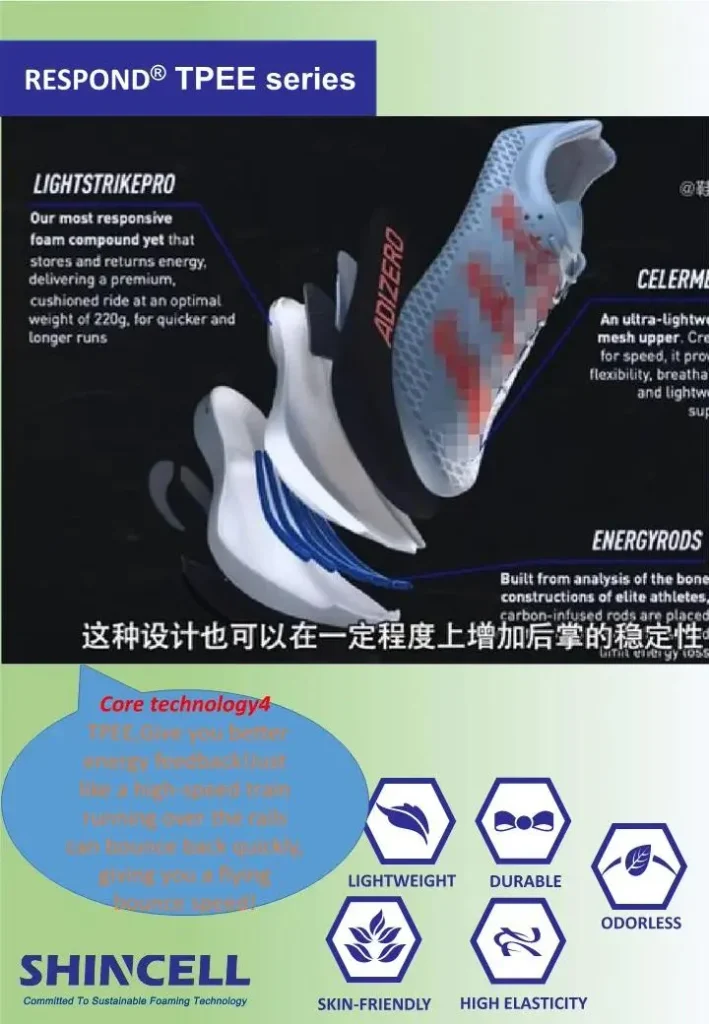
While PEBA offers a slightly squishier initial feel, TPEE delivers two critical advantages for marathon performance:
- Extreme Mechanical Lifespan: TPEE resists permanent cell collapse. Where PEBA-based midsoles often lose their pop after 200–250 kilometers, Lightstrike Pro maintains its structural energy return past 500+ kilometers.
- Thermal Stability: TPEE remains impervious to temperature swings. On cold spring or autumn race mornings, while PEBA and EVA foams stiffen, Lightstrike Pro retains identical compliance and resilience.
The Physics of Confinement
When an elite runner strikes the ground, high-resilience SCF foams compress radically. Without structural intervention, ultra-soft foam deforms isotropically—spilling laterally out the sides and wasting kinetic energy on the horizontal plane.
The carbon component’s true purpose is shear force containment: it restricts lateral expansion, forcing the fluid-like foam matrix to compress purely on the vertical axis and return vector force directly into the athlete’s forward stride.
Part II: EnergyRods vs. EnergyRim – The Usability Split
While Nike locked up the patent for flat, monolithic carbon plates (Flyplate), Adidas took a different path inspired by natural biomechanics: EnergyRods.
By designing carbon structures that mirrored the human metatarsal bones, Adidas allowed the foot to undergo natural sagittal torsion, pronation, and supination during the gait cycle. This anatomical flexibility won the war of long-distance usability, significantly dampening neuromuscular fatigue in the forefoot over 42.195 kilometers.
⚙️ Enter the EnergyRim: A Physical Patch for a Chemical Limit
With the development of the ultra-lightweight Lightstrike Pro Evo foam featured in the Evo 3, Adidas pushed foam density below the critical threshold of 0.07 g/cm³ (exemplified by the 97-gram total weight of the Evo 3). At this sub-density, the polymer matrix becomes thermodynamically unstable under high impact loads—it simply wants to collapse sideways.
To prevent structural failure, Adidas engineers designed the EnergyRim: a rigid, outer perimeter carbon cradle that wraps around the edges of the midsole. Inside product development labs, the EnergyRim is viewed as a transitional mechanical patch—a physical containment wall built to fix a temporary limitation in polymer software.
Part III: The “Sweet Spot” Dilemma – Elite Isolation
The shift from anatomical internal EnergyRods to a perimeter EnergyRim comes at a distinct biomechanical cost: the loss of adaptive torsional flex.
By placing stiff carbon along the outer rim, the shoe becomes highly binary:
- Forefoot / Midfoot Strike (<3:30 min/km / 5:38 min/mi): For elite athletes striking cleanly at high velocity, the EnergyRim provides exceptional straight-line tracking and explosive vertical rebound.
- Heel Strike / Asymmetric Fatigue Landing: If an amateur athlete lands heel-first or breaks down under marathon fatigue, the rigid perimeter wall blocks natural foot pronation. Instead of absorbing impact, the carbon rim transfers the torsional moment of force straight up the kinetic chain into the athlete’s tibia and knee joint.
Part IV: The Future – Continuous Gradient Monomateriality
The next holy grail of footwear engineering will strip away carbon plates and adhesives entirely. Current super-shoes use up to 18 grams of polyurethane solvent adhesives to bond foam slabs to carbon plates, adding dead weight and ruining end-of-life circular recycling.
🔬 Static Cellular Anisotropy via Nitrogen Autoclave
Using a single supercritical nitrogen reactor, ultrasonic pressure drops will be programmed during the molding cycle: Core Microbubbles will be stretched into elongated, vertical ellipses for maximum Z-axis rebound, while Perimeter Microbubbles will remain dense and isometric to form a self-supporting structural shell. The foam will act as its own cradle, rendering carbon rims obsolete.
Part V: Industry Insider Intel & Release Timelines
Based on technical leaks, prototype testing, and supply-chain logistics, here is the current engineering outlook for Adidas’ top-tier road racing lineup:
Part VI: Adios Pro 5 Pre-Release Early Review
Following the lift of the initial media embargo right in time for the Berlin Marathon, major running influencers and YouTubers have flooded the internet with early hands-on material, testing, and structural breakdowns of the highly anticipated marathon racer.
Early consensus centers around a dramatic 23-gram weight reduction compared to the Pro 4, the integration of a ultra-breathable Light Lock upper, and a new structural containment paradigm: replacing the signature standalone carbon EnergyRods with a perimeter-based carbon framework named ENERGYRIM.
The Media Rollout – Notable Influencer Reviews
A curated breakdown of how some running community’s content creators are assessing the initial real-world performance and ride characteristics of the new super-shoe:
Digital & Video Critiques (YouTube)
- The Run Testers: Puts the shoe through a direct head-to-head matchup, evaluating whether the geometric evolution and updated Lightstrike Pro Evo compliance justify a generational leap over the Pro 4.
- Ben Parkes: Shares long-term testing miles accumulated during high-temperature training blocks in Florida, focusing heavily on the structural breathability of the new Light Lock upper and heel lock security.
- Kofuzi: subjects the platform to a diverse battery of athletic stress tests, including aggressive track interval sessions and a simulated half-marathon to gauge metabolic efficiency and late-stage muscular fatigue.
- EDDR Running: Offers a detailed Spanish-language analysis addressing the physical behavior of the new foam geometry during sustained uptempo training and marathon-pace long runs.
- Yanko: Reviews y Zapatillas: Provides a close-up technical inspection focusing entirely on the structural overhaul of the midsole walls and the altered profile of the carbon integration.
Expert Biomechanical Analysis
- Doctors of Running: A dedicated team of physical therapists offers a comprehensive clinical breakdown on their web platform, focusing on the shoe’s visual geometry, heel stability modifications, and how the perimeter rim affects natural foot pronation and joint torque up the kinetic chain.
- Alastair Running: Delivers a highly detailed, data-driven written publication packed with laboratory-spec dimensions, geometric measurements, and mechanical output comparisons.
Key Engineering Takeaways
- The Weight Deficit: The 23-gram mass reduction radically improves operational economy over the full 42.195-kilometer distance.
- The EnergyRim Shift: Transitioning from internal rods to a perimeter carbon cradle provides elite forefoot-strikers with unmatched straight-line tracking but introduces a stricter binary limit for heel-strikers.
- Monomateriality Lifespan: Early runs validate the superior mechanical resilience of Adidas’ supercritical TPEE-based formulation against thermal fluctuations and cell collapse.
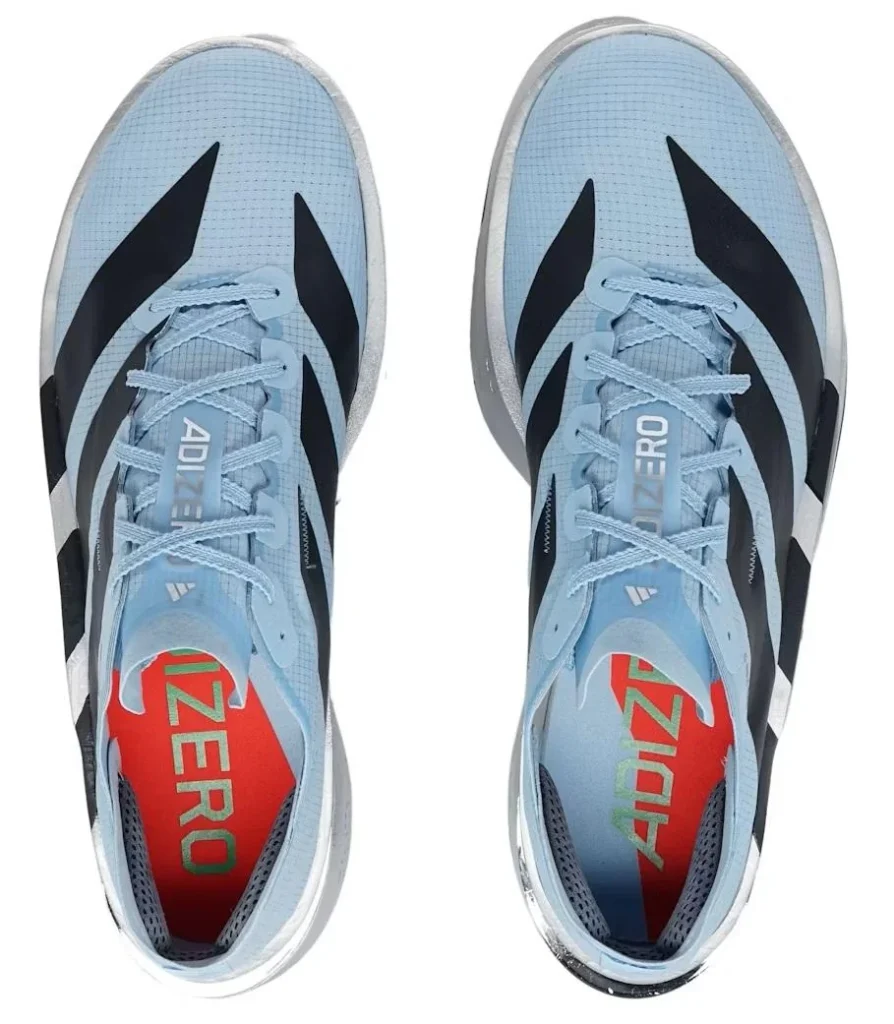
1. Adidas Adizero Adios Pro 5
- Technical Overhaul: Lab samples confirm Adidas is abandoning flat carbon rods in favor of EnergyRods 3.0—hollow, circular carbon tubes combined with a refined EnergyRim cradle. The switch to circular geometry eliminates the micro-fracturing issues experienced under high-wattage pressure in the Pro 3/4.
- Midsole Compound: Full-length dual-density Lightstrike Pro Evo formulation.
- Estimated Release Window: September / October 2026, strategically aligned for the Autumn World Marathon Majors (Berlin, Chicago, New York).
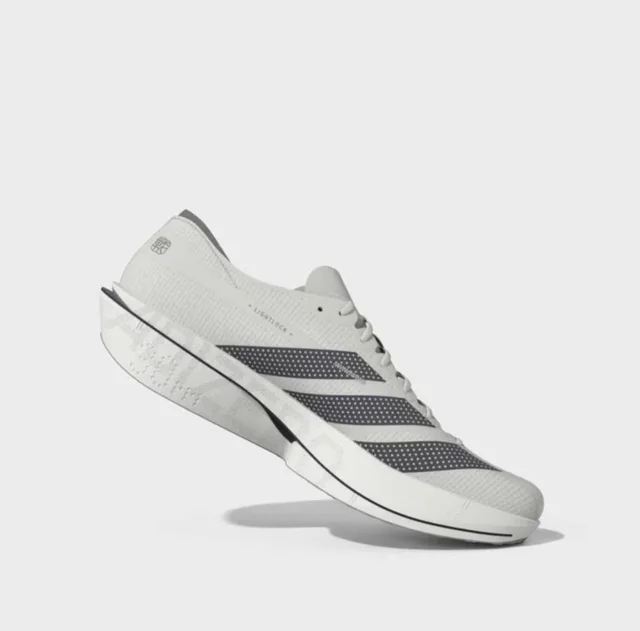
2. Adidas Adizero Takumi Sen 12
- Technical Overhaul: Built specifically for short-distance road racing (5K to 10K), the secret weapon of the Takumi Sen 12 is a low-stack variant of the carbon EnergyRim paired with a ~32mm heel stack.
- Performance Goal: Lowering stack height while rimming the perimeter gives unmatched lateral stiffness for tight urban cornering without ankle roll-over risks.
- Estimated Release Window: Q1 2027, opening the spring global road-racing calendar (Rumours increasingly suggest that the release date will be after Adios 5’s, around October 2026).
💡 Key Technical Takeaways
- Foam is the engine, carbon is the governor: Plates exist to constrain lateral shear and force vertical energy return.
- The EnergyRim is a bridging technology: It cradles ultra-low-density foams (<0.07 g/cm³) until single-foam gradient processing arrives.
- Usability tradeoffs: Outer perimeter carbon rims demand elite forefoot mechanics, narrowing the ideal user profile.
- Adios Pro 5 & Takumi Sen 12: Expect hollow carbon EnergyRods 3.0 in late 2026, followed by a low-stack Takumi Sen 12 in early 2027.
Mr Bürung
A specialist in macromolecular mechanics, Mr Bürung graduated with a Bachelor of Engineering in Biomedical Engineering before completing his Master of Science in Materials Science and Chemical Engineering. His post-graduate research was concentrated on the rheological characterisation of microcellular porous polymers and the thermodynamic phase-separation dynamics of supercritical fluids (SCF).
With over a decade of technical tenure dedicated to the structural design, tooling verification, and mechanical stress-testing of alpine ski and extreme high-altitude mountaineering boots, he consulted extensively for several tier-one manufacturers within Italy’s prestigious Montebelluna footwear engineering cluster. Prior to his retirement, he served as an advanced manufacturing and tooling adviser across applied research institutes and specialised polymer compounding facilities, overseeing automated OEM/ODM injection nodes situated throughout the Klang Valley and Johor industrial corridors in Malaysia.
🔗 References & Technical Sources:
- Explore technical gear discussions on Reddit’s r/RunningShoeGeeks.
- Follow elite race coverage and gear debuts on the LetsRun Message Board.
- Review official performance specifications via the Adidas Adizero Performance Hub.